

Distributors often face communication gaps and quality variations when sourcing blockboard due to technical naming discrepancies.
Our company also frequently encounters such problems, so we wrote this blog to briefly introduce the basic information of blockboard to our clients, in order to ensure that we have the same understanding of the product.
Technical Bridge: Aligning the Definition of Blockboard Construction
One of the greatest challenges in the international timber trade is the “terminology gap.” In some markets, blockboard is referred to as “Lumber Core Plywood.” However, to ensure a successful B2B transaction, we must look deeper into the physical blockboard construction.
A standard blockboard sheet is a composite panel consisting of a core made of seasoned wood strips (timber core) sandwiched between layers of wood veneers. But here is where the confusion often arises: the distinction between Core Veneer and Face Veneer.
The Layered Anatomy
- Timber Strip Core: The “heart” of the board, made of solid wood strips generally 20-30mm wide.
- Core Veneer (The Structural Layer): This is a critical layer often misunderstood. Unlike the paper-thin decorative veneers used in furniture finishing, the core veneer in blockboard is typically 1.5-2.5 mm thick. Its primary function is to bridge the timber strips and provide a flat, stable surface.
- Face/Back Veneer: This is the outermost layer, which can be a functional “Grade B” veneer for painting or a high-end decorative species (like Oak or Teak) for furniture.
The “Double Core Veneer” Advantage (7-Layer Structure)
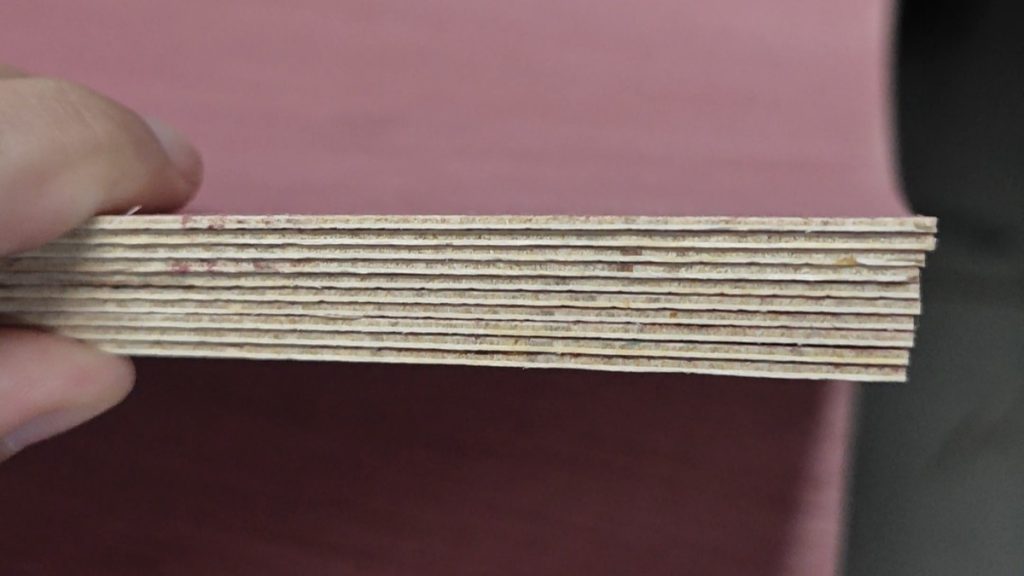
In the premium Chinese manufacturing sector, a specialized structure has emerged to solve the issue of surface “telegraphing” (where the outline of the internal strips shows through the surface). By using a double core veneer on each side—essentially creating a 7-layer board—manufacturers significantly enhance the surface flatness and internal bonding strength. This structure is the gold standard for high-end cabinetry where a high-gloss or thin laminate finish is required.

Types of Blockboard Core: Selecting the Right Species
The mechanical properties of a blockboard sheet are largely dictated by the types of blockboard core used. As a distributor, your choice should depend on the end-user’s requirement for weight versus strength.
- Falcatta / Albasia Core: Originating largely from Southeast Asia, this is the most popular choice for “lightweight” blockboard. It is easy to handle and ideal for interior partitions.
- Pine / Cedar Core: These offer higher density and better screw-holding strength. They are preferred in the Middle Eastern and European markets for heavy-duty shelving.
- Poplar / Paulownia Core: Commonly used in East Asian production, these species offer a balanced weight-to-strength ratio and are excellent for CNC machining.
| Core Type | Average Density | Primary Benefit | Best Application |
| Albasia | 300-350kg/m3 | Extremely Lightweight | Wardrobe interiors, RV furniture |
| Pine | 450-550kg/m3 | High Screw-holding | Load-bearing shelving, doors |
| Poplar | 400-450kg/m3 | Structural Stability | General furniture, office desks |
Blockboard vs Plywood: A Strategic Comparison
For many furniture manufacturers, the choice between Blockboard vs Plywood isn’t about which is “better,” but which is more fit for purpose.
- Bending Resistance: Blockboard has superior longitudinal stiffness. Because the timber strips run the length of the board, it is much less likely to sag over long spans compared to plywood. This makes it the undisputed king for long bookshelves and 2.4 m wardrobe doors.
- Weight: Generally, blockboard is 15-25 % lighter than plywood of the same thickness, reducing the load on hinges and hardware.
- Edge Finishing: Plywood shows distinct layers on the edge, which is often a design feature. Blockboard edges show the timber core and usually require edge banding or “lipping” with solid wood.
Global Market Situation: Demand and Trends
The global market for blockboard remains resilient, valued at several billion dollars with a steady CAGR. Its footprint is particularly strong in regions where traditional woodworking meets modern manufacturing. Regional Consumption Hubs
- The Middle East & North Africa (MENA): This is a high-volume market where blockboard is the standard for interior doors and high-quality residential furniture.
- The United Kingdom & Europe: There is a niche but strong demand for “Technical Blockboard” used in architectural joinery and fire-rated door cores, often requiring FSC or PEFC certification.
- Asia & India: These regions are both major producers and consumers, utilizing local Albasia and Eucalyptus species to fuel the booming real estate sector.
Industry Standards and Compliance
For the export market, compliance is non-negotiable. Leading manufacturers now adhere to:
- Formaldehyde Emissions: CARB P2 (USA) and E0/E1 (Europe/Asia) standards.
- Bonding Quality: Usage of MR or WBP melamine glue depending on the environmental exposure.
Pros and Cons: A Realistic Assessment
To provide your clients with the best advice, you must understand both the strengths and limitations of this material.
Pros:
- Dimensional Stability: Superior resistance to warping in long, narrow pieces.
- Screw-holding: Solid timber strips provide a much firmer grip for screws than the compressed fibers of MDF or the thin veneers of plywood.
- Ease of Machining: Can be worked with standard woodworking tools without excessive wear on blades.
Cons:
- Core Voids: Lower-quality boards may have gaps between the timber strips. Our QC process ensures gaps are limited to less than 1mm
- Surface Consistency: In 3-layer boards, the “grain” of the core can sometimes mirror through to the surface. (This is why we recommend the Double Core Veneer 7-layer structure).
Recent Posts
Why Two 18mm MDF Sheets Can Weigh So Differently
Why OSB/3 Panels Perform Differently by Mill
Why Melamine Board Colors Change Under Different Lighting
A decor can look cool grey in an office, warmer in a showroom, and slightly…
Why Cam Locks Break Out of Particleboard
What Is Plywood? Structure and Core Types for B2B Buyers
What Is Plywood? If a buyer searches for “what is plywood”, they usually need more…
What Is Melamine Board? Melamine Paper, Surface, and Substrate for B2B Buyers
Melamine board is common in furniture, cabinets, office furniture, shelving, interior decoration, and building material…