

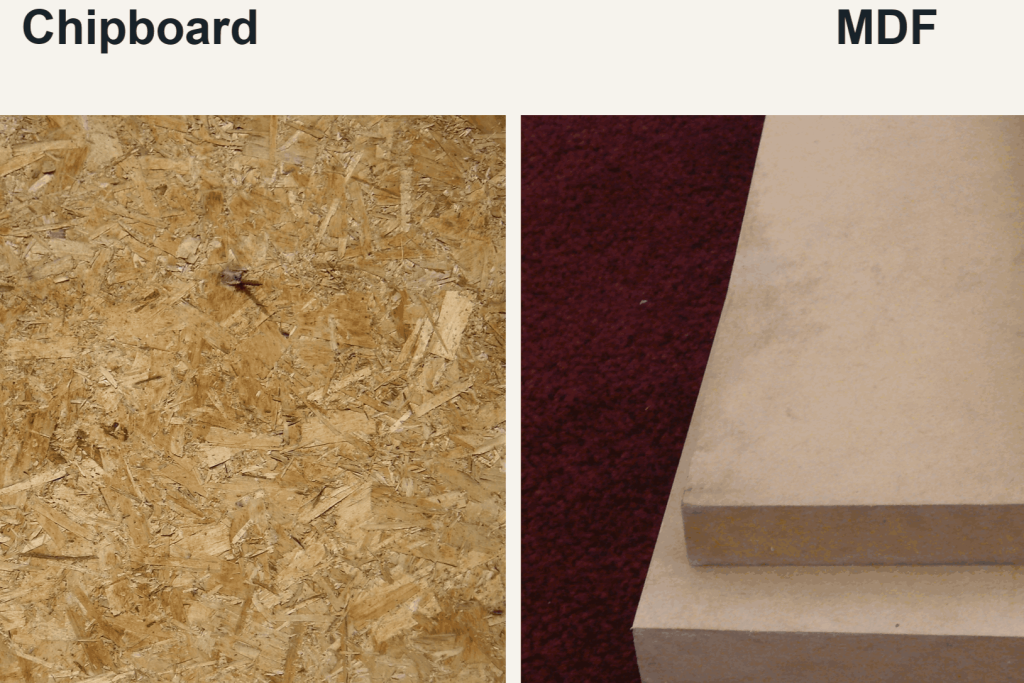
Chipboard vs MDF is not a simple question of which panel is better. For importers, furniture factories, and distributors, the practical question is which panel fits a specific component, machining method, humidity condition, freight plan, and after-sales expectation.
A low board price can disappear quickly if the panel chips during cutting, loses screw holding at a hinge position, absorbs moisture in a warehouse, or creates excessive rejects during edge banding. This guide compares chipboard vs MDF from that B2B purchasing perspective.
Chipboard vs MDF Starts with Structure
Chipboard is made from graded wood particles and shavings pressed into a layered board. MDF is made from refined wood fibers pressed into a more uniform fiber structure. The difference affects surface quality, edge machining, density profile, weight, and the way each panel responds to fasteners and moisture.
The USDA Wood Handbook explains why density profile and moisture behavior matter in wood-based composites. That is why one average density figure cannot explain every machining or service result.
| Factor | Chipboard | MDF | B2B Buying Impact |
| Internal structure | Graded particles with face and core layers | Fine fiber structure with a vertical density profile | Affects machining, edge behavior, and test data |
| Surface | Suitable for melamine lamination when the face layer is stable | Usually smoother for paint and finer routing | Affects finished appearance and downstream process |
| Edge | Depends heavily on density and edge banding | Can be machined into profiles but absorbs moisture easily | Affects chipping, edge banding, and complaints |
| Weight | Often offers a favorable cost-to-weight balance | Often heavier at a comparable thickness | Affects container weight and local handling |
Choose the Panel by Furniture Component, Not Habit
A cabinet carcass, a shelf, a routed door, a drawer side, and a shop fitting do not place the same demand on a panel. Buyers should therefore identify the component first and the panel second.
| Component or Application | Common Starting Point | What to Confirm Before Ordering |
| Cabinet carcasses and shelves | Chipboard is often cost-effective | Density, screw holding, edge banding, shelf loading |
| Routed doors and painted parts | MDF is often easier to machine | Fiber consistency, surface quality, moisture control |
| Long-span shelves or retail fixtures | Depends on span and structural design | Bending strength, stiffness, thickness, reinforcement |
| Humidity-risk interior areas | Panel choice alone is not enough | Moisture grade, edge sealing, holes, storage conditions |
Where Processing Problems Usually Appear
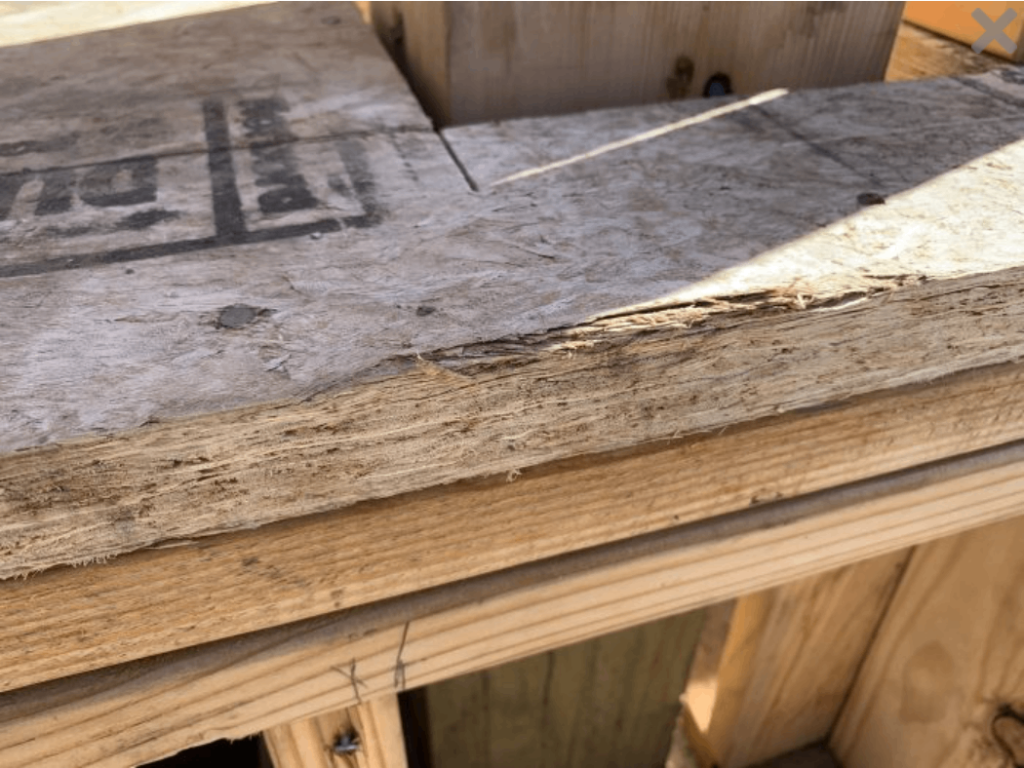
Full sheets can look acceptable in a warehouse. The difference between chipboard and MDF becomes clearer after cutting, drilling, grooving, edge banding, and hardware installation. This is also where distributors receive the most expensive complaints.
| Processing Step | Typical Chipboard Risk | Typical MDF Risk | Pre-Order Control |
| Cutting | Chipping or exposed particles at weak edges | Fine dust, tool wear, and moisture-sensitive edges | Review a cutting sample with the intended saw setup |
| Edge banding | Low-density edges may not bond consistently | Edges may absorb adhesive or moisture | Run an edge banding trial with the buyer’s intended tape and glue |
| Drilling and screws | Screw holding can vary with core density | Performance depends on density and fastener position | Confirm screw type, pilot hole, and hardware position |
| Grooving and routing | Less suitable for detailed profiles | More suitable for routed profiles | Match the board to the customer’s machining method |
Use Test Data Instead of Generic Quality Claims
A professional chipboard vs MDF comparison should use test data obtained at the same thickness and for the same application. MDF often has denser faces and a relatively lower-density core, while chipboard relies more on particle grading and face-to-core construction. Their average density figures should not be treated as interchangeable.
| Test or Data Point | What It Shows | How an Importer Uses It |
| Bending strength and MOE | Strength and stiffness under load | Compare shelves, spans, and fixture applications |
| Internal bond | How well the internal structure holds together | Assess drilling, grooving, transport, and deeper machining |
| Screw withdrawal | Resistance to fastener pull-out | Assess hinges, connectors, and repeated assembly |
| Thickness swell | Thickness stability after moisture exposure | Assess humidity, storage, and moisture-risk applications |
| Surface quality | Suitability for lamination, paint, or film | Assess melamine, veneer, or painted components |
For European-style specifications, buyers may see EN 312 use categories such as P2 for dry interior furniture and P3 or P5 for more demanding moisture or load conditions. The actual requested category must match the supplier’s declared product and test report. A phrase such as ‘moisture resistant board’ is not enough by itself.
Hardware, Hinges, and Shelves Need Their Own Trial
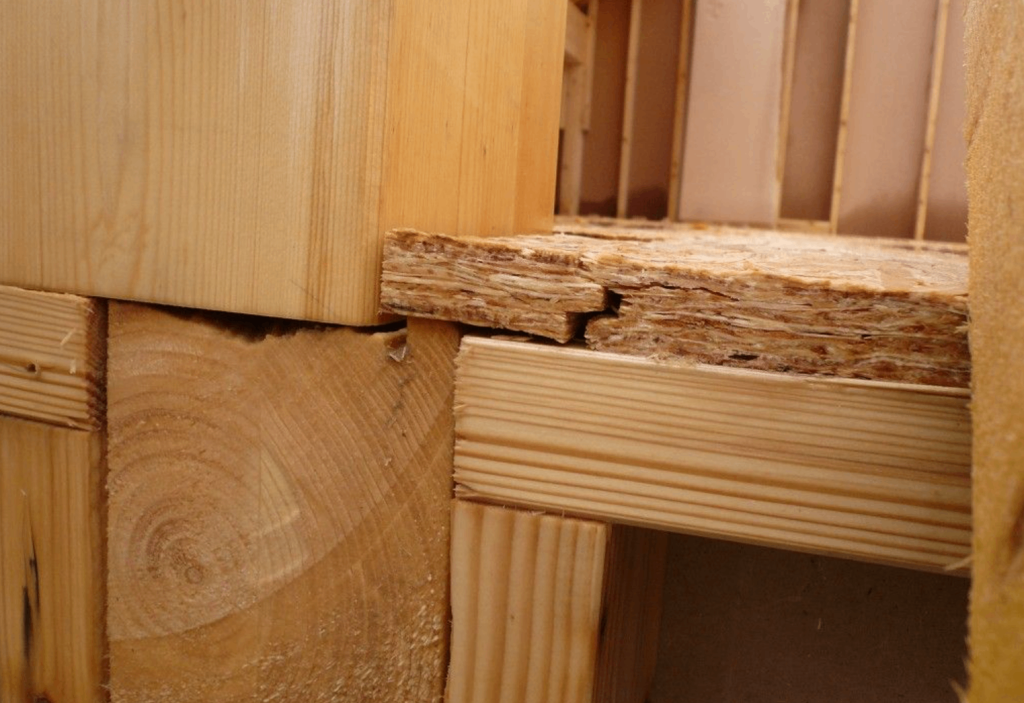
When a buyer asks for good screw holding, the next question should be where the screw will be installed: in the face, the edge, a hinge cup, or a high-load connector. A chipboard suitable for a shelf may not be the best option for a frequently opened cabinet door. An MDF panel suitable for a routed door may not be the most economical cabinet carcass material.
Before a formal order, a small production sample should be cut, drilled, edge banded, fitted with the intended hardware, and checked under a simple load test. This low-cost step often identifies the exact issue that would otherwise become a container-scale claim.
Price, Weight, and Container Loading Must Be Read Together
Chipboard is often selected for a competitive cost-to-weight balance, while MDF can be heavier at the same nominal thickness. However, FOB price alone is not a useful comparison. Buyers should compare panels per container, net weight, local handling cost, expected reject rate, and the value of the finished furniture component.
A useful weight estimate is: panel weight in kg is approximately length in meters multiplied by width in meters, thickness in meters, and density in kg/m3. This helps buyers compare container planning and freight exposure before they choose a lower-density or higher-density option.

Moisture, Storage, and Sea Freight
Neither chipboard nor MDF should be treated as a universally waterproof board. Both can be affected by panel moisture, exposed edges, warehouse conditions, rain exposure, and container humidity. A moisture-resistant grade may improve performance, but it does not remove the need for edge protection and correct storage.
For sea freight, specify cover boards, pallets, steel straps, corner protection, and a stable container-loading plan.
Confirm moisture content, packing, and storage instructions for humid destination markets.
For kitchens, bathrooms, or humid warehouses, specify the substrate, moisture grade, edge sealing, and cut-hole protection together.
Write One Comparable RFQ
- State the end use and furniture component, not only the board name.
- Confirm size, nominal thickness, actual tolerance, density range, and flatness requirement.
- State surface finish and downstream processing: melamine, veneer, paint, cutting, drilling, or edge banding.
- Describe hardware, shelf loading, or fastener requirements when relevant.
- State moisture conditions, packing, inspection, test report, MOQ, and lead-time requirements.
For U.S.-bound orders, the EPA composite wood products formaldehyde standards should be part of the specification file before production begins, not an afterthought after container booking.
Momentimber chipboard and MDF selection support can help buyers compare application, density, surface, edge banding, packing, and inspection requirements against one consistent specification.
FAQ
Conclusion
MelThe right chipboard vs MDF decision is not about choosing a permanent winner. It is about matching the panel to the component, machining method, budget, freight plan, humidity risk, and customer expectation. That is how an attractive purchase price becomes a controlled delivered cost.
recent posts
Sanded OSB for Furniture Still Needs a Finish Plan
OSB material reference only; sanding quality and the final finish need separate approval. Sanded OSB…
Plywood vs OSB for Crates Is More Than a Price Choice
Protected panel bundles are a supply-stage reference, not an approved design for a shipping crate….
Blockboard vs Finger Joint Board for Furniture Buyers
A visible timber-strip core does not make the finished panel the same as an exposed…
Synchronized Melamine Board Goes Beyond the Print
Woodgrain design reference only. A flat image cannot demonstrate EIR texture or alignment. Synchronized melamine…