


Furniture makers often lose money by choosing the wrong panel for the wrong job, leading to broken parts or customer complaints. This blog explains the technical differences between HDF and MDF, helping you select the most cost-effective and durable material for your specific market needs.
Defining the Core: What They Really Are
To make a smart buying decision, you must first understand the mdf meaning. MDF, or Medium Density Fiberboard, is an engineered wood product made by breaking down wood residuals into fine fibers. These fibers are mixed with wax and a resin binder, then pressed into sheets under high heat.
The hdf board, or high density fiberboard, follows a very similar process. The main difference lies in the pressure and the amount of wood fiber used. While they look similar to the naked eye, their internal “compactness” is quite different. For a B2B buyer, knowing which one to stock depends entirely on whether your customers are building lightweight furniture or heavy-duty flooring.
Density Comparison
Density is the most important factor in the wood panel industry. It tells you how much wood fiber is packed into every cubic meter of the board.
The Density of MDF
The density of mdf wood usually ranges from 600-800m3. This range makes it very easy to cut and profile. If you are manufacturing cabinet doors with complex designs, MDF is the best choice because it does not chip easily when routed.
If the density is too low, the core becomes “furry” or porous after machining, leading to excessive paint absorption and a poor finish. Professional-grade MDF ensures that the fiber distribution is consistent from the surface to the center.

The Density of HDF
An HDF panel is much more compact, with a density usually above 800 kg/m3. Because it is pressed much harder, it is thinner and stiffer than standard fiberboard. This high density makes HDF the perfect core material for laminate flooring, as it can resist the heavy weight of footsteps and furniture without denting.
| Feature | MDF (Medium Density) | HDF (High Density) |
| Average Density | 600-800 kg/m3 | Over 800 kg/m3 |
| Main Use | Furniture, Cabinets, Mouldings | Flooring, Door Skins, Back Panels |
| Machinability | Excellent for routing/shaping | Better for flat, high-stress use |
| Weight | Lighter and easier to handle | Heavy and very rigid |
Comparing Structural Integrity: HDF vs MDF
When evaluating HDF vs MDF for industrial furniture or construction, base your decision on the mechanical loads and environment.
Screw-Holding and Machinability
Because MDF is less dense, it allows for easier screw penetration without the risk of splitting, provided pilot holes are used. However, the higher density of an hdf board provides a much tighter grip on fasteners, which is essential for furniture that will be assembled and disassembled multiple times. The tradeoff is that HDF is harder on cutting tools.
Dimensional Stability
The compact nature of HDF makes it less sensitive to changes in humidity compared to standard MDF. While neither is fully waterproof, the lower swelling rate of HDF is a massive advantage in tropical or coastal markets. For distributors stocking mdf board 4×8 sheets, understanding the regional humidity is key to preventing warping in the warehouse.

Choosing the Right Material for Your Application
The debate of hdf vs mdf usually comes down to two things: the budget and the final use of the product.
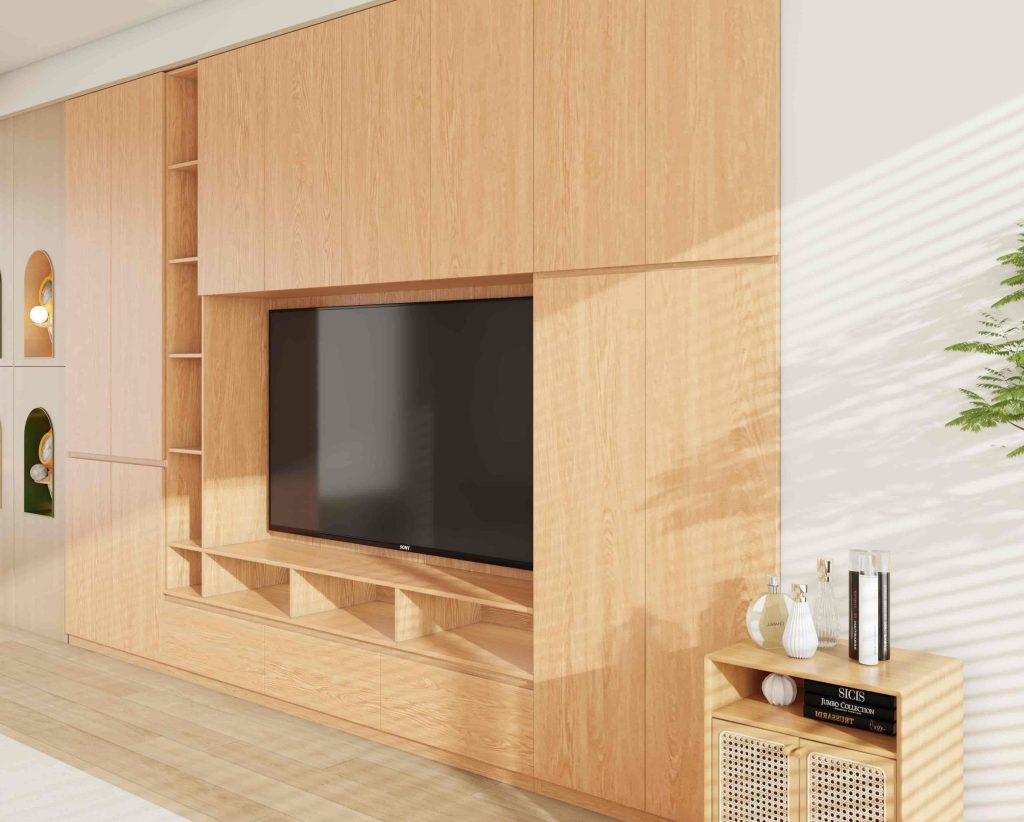
- Furniture Production: If your clients are making wardrobes, tables, or shelving, MDF is almost always the winner. It is more affordable and easier to paint. The smooth surface of MDF allows for a high-gloss finish that looks like solid wood.
- Flooring and Doors: If you need a panel that is thin but extremely tough, you need HDF. Because of its density, HDF does not absorb moisture as quickly as MDF, making it the ideal core material for high-quality laminate floors.
- Wall Paneling: For decorative wall slats or acoustic panels, prefer MDF because it is easier to install and puts less weight on the wall structures.
Sourcing Insights: Identifying Fiberboard
Experienced distributors know that two boards with the same density of mdf wood can still perform differently. To ensure you are sourcing a professional-grade product, look for these markers:
- Fiber Color: A light, consistent color usually indicates the use of virgin softwood fibers (like pine). Darker spots or a very dark core often mean recycled content or hardwood residuals, which can affect paint consistency and tool wear.
- Surface Sanding: A high-quality mdf board 4×8 should have a smooth finish. If you are manufacturing cabinet doors with complex designs, choose MDF because it does not chip easily when routed.
- Formaldehyde Emission: For the B2B market, E1 is the minimum, but E0 and CARB P2 are now becoming the standard for high-end furniture manufacturers aiming for international exports.
Conclusion
In the final analysis of hdf vs mdf, there is no single “better” board. Standard MDF offers the versatility and ease of machining required for the majority of furniture applications. Conversely, the hdf board provides the extreme density and durability needed for high-stress environments like flooring and structural skins.
Are you evaluating fiberboard suppliers for your next quarter? We offer high-performance MDF and HDF panels, including 3/4 mdf and custom-sized mdf board 4×8 sheets, all manufactured to strict ISO and CARB standards.
Would you like me to send a detailed technical comparison sheet or a physical sample kit to test the density and screw-holding of our current production? Contact our B2B export team today.
recent posts
Sanded OSB for Furniture Still Needs a Finish Plan
OSB material reference only; sanding quality and the final finish need separate approval. Sanded OSB…
Plywood vs OSB for Crates Is More Than a Price Choice
Protected panel bundles are a supply-stage reference, not an approved design for a shipping crate….
Blockboard vs Finger Joint Board for Furniture Buyers
A visible timber-strip core does not make the finished panel the same as an exposed…
Synchronized Melamine Board Goes Beyond the Print
Woodgrain design reference only. A flat image cannot demonstrate EIR texture or alignment. Synchronized melamine…