

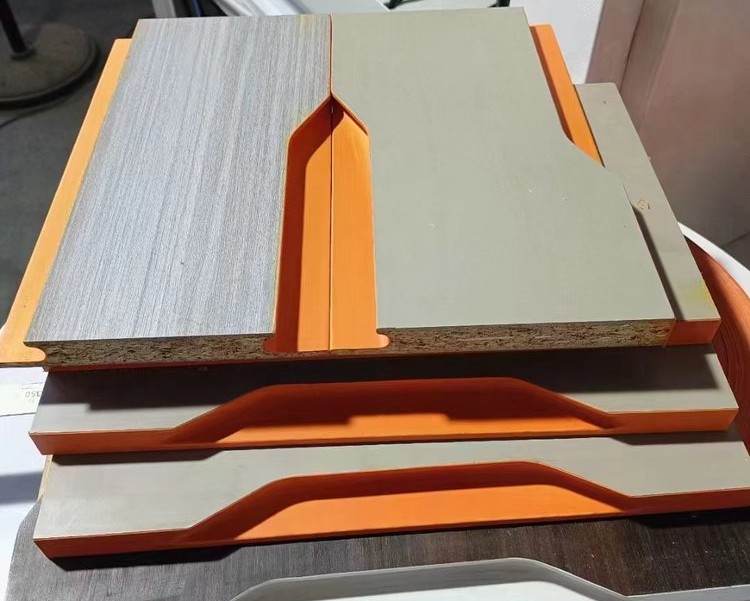
A customer sends a photo of a cabinet door and says, “Please repeat the same oak decor.” The new sheets arrive with a close-looking face, yet the workshop finds that the doors sit proud, the drilling depth changes, or the edge band no longer closes neatly. This is a common melamine board repeat orders problem. The decor matched the eye, but the board system did not match the component.
For an importer or distributor, that distinction matters. A melamine-faced board is not only a colour card. It is a decorative surface bonded to a selected substrate, with an agreed thickness, face configuration, texture, edge treatment and machining route. A successful repeat order keeps those items connected to the actual cabinet part. It does not rely on a photograph, a decor name or a small offcut alone.
Key takeaways:
1. Matching decor does not prove that a repeat board will fit the same cabinet component.
2. Record the surface system and substrate system separately: decor, texture, gloss, core, thickness and face configuration.
3. A swatch cannot confirm drilling depth, door clearance, edge-band fit or hardware performance.
4. Keep a finished Golden Sample component, not only a loose board sample.
5. Treat changes to core, thickness, texture, edge band or sheet source as approval triggers before bulk production.
Why a Matching Decor Can Still Miss Cabinet Fit
The phrase “same melamine board” often hides several separate decisions. The Melamine Board product range may use MDF or particleboard as its substrate. It may be single faced or double faced. It may carry a different texture or gloss even when the printed decor is close. Each choice can change the way a component cuts, drills, edges, weighs or fits against the next part.
This is not just a supplier preference. The current EN 14322 standard summary describes decorative melamine-faced boards for interior use in terms of both surface requirements and dimensional tolerances. In other words, the board is evaluated as more than an image on the face. A repeat-order record needs to do the same.
| What looks the same | What may have changed | What the workshop notices |
|---|---|---|
| Oak or walnut decor name | Substrate, face build, sheet thickness or texture. | Door clearance, drilling depth, cut edge or component weight changes. |
| Similar colour under warehouse light | Gloss level, embossing direction or batch appearance. | Adjacent doors look different after installation or under shop lighting. |
| Same nominal 18 mm | Actual thickness range, tolerance or face configuration. | Hinges, drawer runners and pre-set CNC programs no longer land in the expected position. |
| Same edge-band colour | Band thickness, gloss, texture or adhesive-side specification. | Visible edge reads differently or the edge does not close as expected. |
| Same board label | Single/double face, backing, core grade or packing condition. | One side differs visually, the panel moves differently, or processing waste increases. |
Separate the Decorative Surface From the Substrate
The first control point is simple: write down which part of the product is the surface system and which part is the substrate system. Melamine decorative paper and resin create the finished face. MDF or particleboard supplies the internal structure. A familiar decor can be pressed onto more than one core, but it does not make those cores interchangeable for every cabinet job.
The article Can You Change the Substrate Without Changing the Decor? explains the commercial risk of switching cores while keeping a familiar face. For a cabinet repeat order, go one step further: ask whether the original component was designed around that specific core. Hardware position, screw performance, edge quality, weight and moisture boundary can all depend on it.
Melamine-faced MDF
Melamine-faced MDF can be useful where a smooth, uniform substrate is needed for precise machining and a finished decorative face. The sheet may perform well for cabinet sides, drawer fronts or internal components, but the buyer should still define the edge-band process and drilling plan. If the original sample used MDF, do not assume that a particleboard substitute will behave the same at a hinge cup, a routed feature or a narrow visible edge.
Melamine-faced particleboard
MFC is widely used for interior furniture components, especially where an economical ready-faced panel and consistent flat sheet are needed. Its result depends on the selected particleboard, face layers, edge-band treatment and intended load. The Raw Particleboard vs Melamine Faced Chipboard guide helps distributors explain the difference between an unfinished board and the final faced product to their downstream customers.
The Four Fit Checks a Swatch Cannot Answer
A small decor sample is useful for colour approval. It cannot prove that an installed component will fit. Before releasing a repeat container, use one full-size sheet or a finished component to check the points that create the most expensive late surprises.
| Fit check | Practical method | Evidence to keep |
|---|---|---|
| Thickness and face build | Measure multiple points on the board and compare with the approved component and CNC setup. | Dated measurements, specification range and a labelled retained sample. |
| Texture, gloss and grain direction | Place the new panel beside the approved part under normal shop and side light. | Photos showing both panels, decor code, texture and grain-direction reference. |
| Edge-band match | Run the planned band on a cut component, then inspect the joint and visible edge from normal viewing distance. | Edge-band supplier code, band thickness, adhesive process and trial photos. |
| Hardware and assembly | Drill the actual hinge, connector or runner position on a representative part. | Finished trial component with hardware, drilling drawing and pass/fail notes. |
A useful rule is that the repeat sample must include the same critical operations as the finished product. A face-only approval does not test a concealed hinge. A flat sheet does not test an edge band. A colour card does not test whether a CNC depth setting still leaves the intended clearance.
Build a Repeat-Order Control Card, Not a Loose Sample File
Distributors are often asked to repeat a customer project months after the first delivery. By then, the original board may be gone, the cabinet shop may have changed staff, and the photograph may be the only record. A short control card turns an uncertain repeat request into a comparable specification. Keep it with a labelled Golden Sample component and the approved edge-band piece.
| Control-card field | What to record | Why it protects the repeat order |
|---|---|---|
| Surface identity | Decor code, texture, gloss, grain direction and face/reverse requirement. | Prevents a close-looking but visibly different face from being approved by name only. |
| Substrate identity | MDF or particleboard, intended application, density or weight reference where relevant. | Links the visible face to the machining and hardware behaviour the customer approved. |
| Dimensions | Sheet size, nominal thickness, agreed tolerance and squareness requirement. | Protects CNC settings, cabinet clearances and cut-list yield. |
| Edge details | Band material, decor code, thickness, gloss or texture, and visible edges. | Stops a matching face from being paired with an obviously different edge. |
| Component evidence | Door, side, shelf or drawer-front sample with drilling and edging completed. | Tests the actual fit rather than assuming a board offcut represents the whole component. |
| Order traceability | Purchase order, bundle label, inspection photos and date of approval. | Gives both buyer and supplier a fair reference if a later claim is raised. |
Texture still belongs on this card, but it should not carry the whole decision. Our Melamine Board Texture Repeat Orders article covers how embossing and gloss can change the visual result. In a cabinet program, record those surface details beside thickness, core and edge details so the workshop can use one document instead of guessing from several samples.
Use Change Triggers Before a Bulk Repeat Order
A new quotation does not always mean a new technical product. But some changes are too important to hide in a quotation line. The buyer should require written approval and a representative trial whenever one of the agreed points changes. This is especially important when a project is repeated after a long gap, when the original component had tight gaps, or when several suppliers are involved in the same program.
- The substrate changes from MDF to particleboard, or from one agreed core system to another.
- Nominal thickness, agreed tolerance, sheet size or face configuration changes.
- The decor uses a different texture, gloss, press plate, grain direction or backing.
- The edge-band reference, thickness or visible-edge rule changes.
- The cabinet part introduces new routing, drilling, hinge, connector or runner positions.
- The material will be stored or used in a different humidity condition from the approved program.
The EN 14322 text also points to supporting methods for surface soundness and screw withdrawal. An importer does not need to run a laboratory for every repeat order. The practical lesson is to identify the component risk, retain the approved evidence, and use a representative production trial when that risk could change.
Make the First Cabinet Component the Golden Sample
A Golden Sample is strongest when it is a finished item that customers recognise. For cabinet work, retain one door, side or drawer front with the intended face, edge band, drilling and hardware. Label it with the order number and core system. Keep a small board offcut beside it, but do not let the offcut replace the component.
If a later delivery is questioned, compare the first opened sheets and one freshly machined component with that Golden Sample before assigning blame. Check bundle labels, face and reverse side, caliper readings, edge-band reference and drilling result. This creates a fair claim record: it can show whether the issue came from the board, a substitution, a changed workshop process, storage or a mistaken assumption about the original specification.
RFQ wording to adapt:
Melamine-faced board for [cabinet component], [sheet size] x [nominal thickness and tolerance]. Surface: [decor code], [texture], [gloss], [grain direction], [single/double face and backing]. Substrate: [MDF or particleboard] for [application]. Edge band: [reference, thickness and visible-edge requirement]. Approve a finished component including the intended drilling and hardware before bulk production. Any change to surface, core, thickness, edge band or component machining requires written approval.
A Repeat Order Should Reproduce the Component, Not Just the Colour
The goal is not to make repeat buying complicated. It is to keep the few details that decide whether a cabinet line installs cleanly. When decor, texture, substrate, thickness, edge and hardware trial are tied to one approved component, a distributor can quote with more confidence and a workshop can repeat its process without blind adjustments.
Momentimber supports specification matching, sample review, production follow-up, inspection and packing records for faced-board programs. Our company profile explains this supplier-service role. Share the existing sample, component drawing, edge-band reference and target market before a repeat order, and we can help turn them into a practical control card.
Related Reading
Sanded OSB for Furniture Still Needs a Finish Plan
OSB material reference only; sanding quality and the final finish need separate approval. Sanded OSB…
Plywood vs OSB for Crates Is More Than a Price Choice
Protected panel bundles are a supply-stage reference, not an approved design for a shipping crate….
Blockboard vs Finger Joint Board for Furniture Buyers
A visible timber-strip core does not make the finished panel the same as an exposed…

Synchronized Melamine Board Goes Beyond the Print
Woodgrain design reference only. A flat image cannot demonstrate EIR texture or alignment. Synchronized melamine…
Lightweight MDF vs Standard MDF for Furniture Parts
Panel appearance alone does not identify a lightweight MDF grade. Lightweight MDF can make a…
Film Faced Plywood Edge Sealing After Cutting
Film faced plywood edge sealing needs to follow the cutting and drilling plan. Factory edge…
Melamine Board Orders: Why the Same Decor Can Arrive With a Different Texture
Keep embossing, gloss and side-light approval under control when a repeat order must match installed furniture.
Can You Change the Substrate Without Changing the Decor?
See why a familiar melamine face should not make MDF and particleboard cores automatically interchangeable.
Melamine Board Cutting Yield: Why Woodgrain Direction Changes the Cut List
Plan grain direction early so repeat panels match visually and the cutting plan does not create avoidable waste.
Planning a melamine-faced cabinet repeat order? Send the approved component, decor and edge-band references, drilling drawing and target application. We can help prepare a practical control card before bulk production.
Contact Momentimber about melamine board repeat-order control.