

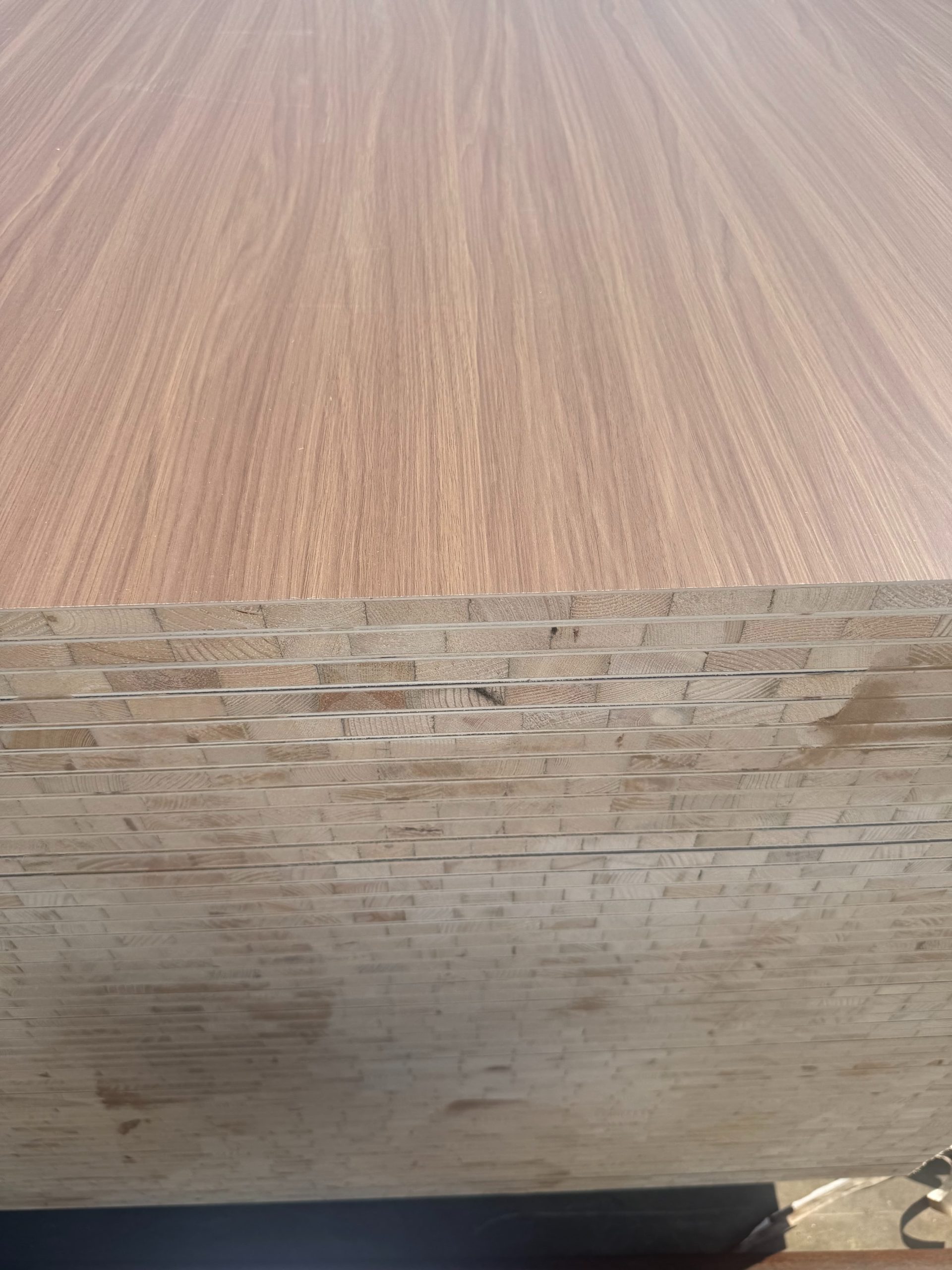
A melamine blockboard cutting trial may produce a clean surface at first, yet chip the face in a furniture shop. That does not automatically mean the whole batch is defective. First identify where the chip appears: on the entry face, the exit face, along a core strip joint, or only on one edge of one sheet. The pattern helps separate a board issue from a blade, feed, support or handling problem.
For an importer, that distinction changes the claim. If a distributor blames the mill for every chipped edge, the workshop may keep using a worn blade. If the supplier blames the saw without checking the core and face build-up, a real construction problem may be missed. A useful melamine blockboard cutting review compares the approved sample and current sheets under the same practical cutting conditions.
Key takeaways:
1. A chipped edge is a symptom, not proof of a defective board.
2. Record which face chipped, where the cut began and whether the problem repeats across sheets.
3. Melamine surface, blockboard core construction and saw setup all affect the finished edge.
4. Compare a current sheet with a retained Golden Sample using the same machine and settings.
5. Put the application, surface, core and agreed cut-edge expectation in the order file.
A Chip on the Edge Is a Symptom, Not a Verdict
Melamine decorative paper is a thin, cured surface bonded to a wood-based panel. The surface is designed for interior use, but a saw tooth still has to enter and leave it cleanly. A cut that tears the face layer can expose the substrate beneath. That exposed edge may then be hidden by edge banding, remain visible, or become the start of a customer complaint.
The surface system and the substrate system should be assessed separately. Momentimber describes the range of melamine-faced board options by both the decorative face and the selected core. In this article, the core is blockboard: a panel built around wood strips and face layers. Its edge structure is not identical to particleboard or MDF, so results from another board type should not be treated as an automatic pass or fail for blockboard.
The Wood Panel Industries Federation groups storage, handling, cutting, fixing and finishing guidance together in its PanelGuide. That is a useful reminder: the quality of a cut is not created by the panel alone. The workpiece, machine condition and handling route matter too.
Read the Cut Pattern Before You Change the Specification
A quick inspection with good light is often enough to decide what to check next. Do not begin by measuring every sheet or requesting a laboratory report. Photograph the full cut, then take a close-up that shows the face, edge and core. Mark the sheet identity and the direction of the cut.
| What you see | Possible contributors | First practical check |
|---|---|---|
| Small chips mostly on the saw exit face | Tooth direction, insufficient face support, blade condition or cut setup | Repeat a short cut with the same sheet orientation and stable support |
| Chips on both faces along most of the cut | Dull or unsuitable blade, vibration, feed inconsistency or poor alignment | Check blade cleanliness, runout, fence/guide and feed consistency |
| A larger breakout at one point near a core line | Local core joint, gap, face-layer support or a damaged area | Mark the location and compare it with another cut from the same sheet |
| One sheet chips while nearby sheets cut cleanly | Local panel variation, handling damage or a sheet-specific condition | Repeat with a retained sample and inspect several sheets across bundles |
| The face flakes before the saw reaches the panel edge | Surface damage, impact, poor storage or a local bonding/press issue | Photograph before cutting and compare with an untouched area |
These are starting points, not final diagnoses. A chip near a core joint does not prove that the joint caused it; a worn blade can make a sound panel look poor. The useful question is whether the defect repeats in the same place and under the same conditions.
Three Systems Meet at the Saw
A clean edge depends on three things working together: the decorative surface, the panel construction and the cutting system. If one changes between sample approval and production, the result can change even when the product name on the invoice stays the same.
1. The melamine surface
Decorative paper, resin, texture and pressing create the visible face. Paper condition, surface damage before cutting and the way the face is supported as teeth pass through it can all affect whether the surface chips. A cut made across a textured or directional decor may also look worse than a similar chip on a plain colour because the broken edge interrupts a visible pattern.
2. The blockboard core and face build-up
A blockboard core contains timber strips, while the layers above and below help create a usable flat surface. Strip joints, local gaps, face-layer condition and panel flatness become visible at the cut edge. The blockboard product page identifies the core and the melamine surface as separate parts of the panel; for a cutting trial, ask the supplier to identify the construction represented by the sample rather than approving only its decor.
This is also why a result from MFC should not be copied directly to melamine blockboard. Market names also shift by region. Our explainer on pressed wood, particleboard and chipboard terms shows why the purchase file should identify the physical core rather than rely on a broad shop-floor name. A more uniform particleboard core can behave differently from a strip core when the saw crosses an internal joint or an area with less support.
3. The saw, blade and support
Blade sharpness, tooth geometry, machine alignment, vibration, feed consistency and support beneath the sheet all influence the cut. Tooling suppliers such as Leitz describe blades intended for difficult-to-machine and melamine-coated panel materials in their panel-processing information. The practical lesson is not to buy one named blade for every shop; it is to check that the machine setup is suitable for the specific panel and cut direction.
For production teams, note which face was up, the blade in use, whether a scoring unit or backing support was used, and whether the chip appeared at entry or exit. You do not need to turn a small claim into an engineering investigation. A short, repeatable record can tell you whether the problem follows a sheet or follows the machine.
Why a Blockboard Cut Can Look Different from an MFC Cut
Both products may have a similar melamine face, but their cores differ. MFC usually refers to melamine-faced chipboard or particleboard. Blockboard uses a strip-based core with face layers. As a result, the edge exposed by cutting can reveal different local structures. Edge banding can cover the core, but it does not erase a poor cut or make two substrates interchangeable.
When a customer reports chipping, ask whether the damage is limited to the decorative layer or whether the core also breaks away. A thin surface flake and a deep edge breakout have different commercial consequences. The first may be hidden by a defined edge treatment; the second can reduce the usable component width or compromise a visible corner.
If the customer also reports loose fittings or breakout around holes, keep that as a separate symptom. The troubleshooting approach in cam-lock breakout from particleboard shows why hole geometry and machine setup need their own checks. A saw-edge claim should not be merged with a hardware claim simply because both occurred on the same furniture order.
Run a Small Cutting Trial Before the Full Job
A distributor does not need a special laboratory to make a useful first comparison. The downstream furniture shop already has the saw, edge bander and parts list that will determine whether the board works in production. Ask the customer to retain a reference piece and follow a simple, repeatable trial before processing a large order.
- Identify the panel: write down the core, thickness, decor, face configuration, bundle and sheet position if known.
- Keep the sample: mark an approved Golden Sample and a current production sample so the two cannot be confused.
- Use one setup: cut both samples with the same machine, blade, feed method, face orientation and support.
- Record the pattern: photograph the whole cut and close-ups of entry, exit, both faces and any exposed core joint.
- Repeat across sheets: try several sheets from more than one bundle before deciding the issue is consistent.
- Check the next process: apply the planned edge band or edge finish and confirm that the part still meets the customer’s appearance requirement.
If a panel is supplied cut-to-size, define the finished dimensions and edge appearance before production. If the customer will cut full sheets locally, the trial should use the customer’s actual equipment. The supplier can help compare samples, but cannot promise the same cutting result on every unverified machine setup.
What to Put in the RFQ and Approval Record
A quotation that says only “melamine blockboard, 18 mm” does not define how a visible edge should look after cutting. The RFQ should identify the surface and the core, then connect the sample to the intended machining route. If the final edge will be covered, state that too; a covered edge and a clean exposed edge are different acceptance targets.
| Order-file item | What to record | Why it matters |
|---|---|---|
| Panel identity | Core construction, nominal size, thickness and agreed tolerance | Prevents a decor name from standing in for the complete product |
| Surface | Decor reference, texture, face sides and approved sample | Connects appearance complaints to the correct surface specification |
| Application | Visible edge, edge-banded edge, door, shelf or other component | Defines the actual quality requirement after processing |
| Cutting trial | Machine type, blade condition, face orientation and trial result | Makes sample and production comparisons more meaningful |
| Acceptance evidence | Labelled sample, photos, sheet/bundle reference and date | Creates a usable record if the issue repeats |
| Packing and receipt | Edge protection, bundle labels, arrival condition and damage photos | Separates transit damage from cutting damage |
For melamine-faced products, the BSI summary of BS EN 14322 describes requirements and dimensional tolerances for melamine-faced boards used indoors. It is useful background for identifying the product category, but it does not define the buyer’s saw, blade, edge-banding process or a universal post-cut chip limit. Put those application-specific expectations in the approval record.
When a Cutting Claim Reaches the Supplier
Do not ask the supplier to accept or reject a claim from one phone photo. First preserve the evidence. Keep the affected part, an uncut piece from the same sheet if available, the bundle label and the approved sample. Record how many sheets were checked and whether the problem appeared on the same face or position.
- Photograph the defect before trimming or edge banding hides it.
- Show the full component, the close-up, the board edge and the bundle label in separate images.
- Record which saw and blade were used, whether the blade was recently changed, and how the sheet was supported.
- Compare one affected sheet and one unaffected sheet from the same shipment using the same setup.
- Keep the approved sample and current sample labelled; do not rely on memory or a screen image for colour and texture.
This approach does not assume the supplier is right or the customer is wrong. It gives both sides enough information to decide whether to inspect the board construction, review the cutting process, or repeat the sample trial. For order coordination, connect the specified panel, retained sample and production evidence in one clear file.
The Practical Decision
A melamine blockboard edge that chips during cutting should trigger a short diagnostic, not an instant material change. Check the cut pattern, compare current and approved samples under one setup, and look at whether the core breaks away with the surface. Then agree the acceptance target for the actual part: visible edge, edge band, or cut-to-size supply.
If the issue follows one sample across repeat cuts, ask the supplier to review that panel and its construction. If it appears only with one machine setup or one blade condition, correct the process before changing the board specification. Keep the evidence with the order file so the next quotation and repeat order start from a clearer standard.
Frequently Asked Questions
Related Reading
Sanded OSB for Furniture Still Needs a Finish Plan
OSB material reference only; sanding quality and the final finish need separate approval. Sanded OSB…
Plywood vs OSB for Crates Is More Than a Price Choice
Protected panel bundles are a supply-stage reference, not an approved design for a shipping crate….
Blockboard vs Finger Joint Board for Furniture Buyers
A visible timber-strip core does not make the finished panel the same as an exposed…

Synchronized Melamine Board Goes Beyond the Print
Woodgrain design reference only. A flat image cannot demonstrate EIR texture or alignment. Synchronized melamine…
Lightweight MDF vs Standard MDF for Furniture Parts
Panel appearance alone does not identify a lightweight MDF grade. Lightweight MDF can make a…
Film Faced Plywood Edge Sealing After Cutting
Film faced plywood edge sealing needs to follow the cutting and drilling plan. Factory edge…
What Is Blockboard? Its Product Structure and Market Situation
Review strip-core construction and the product details that should be confirmed before specifying a faced panel.
Raw Particleboard vs Melamine Faced Chipboard
Separate the substrate from the decorative surface when comparing board options and supplier quotations.
How Woodgrain Direction Changes Melamine Board Yield
See how decor direction affects component layout, cutting yield, SKU labels and repeat-order consistency.
Agree the Edge Before the Order
Send the panel construction, decor reference, thickness, intended component and a photo of the cut issue. We can help clarify the specification, compare a retained sample and coordinate the next production or inspection steps.
Contact Momentimber to review a melamine blockboard specification.