

Particleboard raw materials cannot be ranked by a fresh-wood label alone. A quote may describe virgin wood, sawmill residues or recycled wood. These terms describe supply streams, not finished-panel grades. Ask what the label includes and whether the offered board suits your furniture part. That is more useful than paying extra for a material description the supplier cannot define.
For an importer, the practical issue is consistency. A sample may machine well while the next quotation carries a different raw-material description. That does not automatically mean a worse board. It does mean the two offers need a clear comparison before you promise the same performance to your customers.
Key takeaways
- Separate wood species, source stream and particle preparation.
- Fresh wood and recycled wood are not finished-board performance grades.
- For MFC, approve the substrate as well as the decorative face.
- Agree what changes require notification on repeat orders.
Particleboard Raw Materials Describe Three Different Things
When buying particleboard, start by separating three questions. Which wood or other declared material is used? Where does it come from? How is it prepared into particles? A species answer cannot replace a source answer, and neither tells you the finished board grade.
The European Panel Federation particleboard overview describes panels made with wood particles and adhesive. It lists several particle forms and notes that recycled sources may be included. That supports asking about the actual feedstock. It does not provide a quality ranking for the boards on your quotations.
Consider a hypothetical pair of offers. One says fresh poplar, while another says selected recycled wood. Neither statement tells you whether the sheet matches a cabinet-side specification. You still need the identified panel, thickness basis and intended use before treating the two prices as alternatives.
| Description in an offer | What it describes | What remains unanswered |
|---|---|---|
| Poplar, pine or mixed wood | Species or a supplier wood-mix description. | Source, preparation and finished product properties. |
| Virgin or fresh wood | A stated non-recovered input stream. | Exact definition, scope and finished-panel suitability. |
| Sawmill residues | A material source associated with wood processing. | Whether the residues are clean, consistent and suitable. |
| Recycled or reclaimed wood | A recovered-material claim needing a definition. | Origin, controls, reporting basis and product identity. |
Fresh Wood Is a Source Claim, Not a Quality Certificate
Ask what fresh means in the supplier conversation. It might mean newly harvested timber, non-recovered chips or simply material without old coatings. Write down the intended meaning. Otherwise, two people can agree to the same phrase while expecting different raw materials.
Do not confuse fresh with wet. A source description is not a delivery moisture specification. Likewise, a clean-looking chip does not establish the bonding or dimensional behaviour of a finished sheet. Treat those as different product questions instead of asking the word fresh to answer them all.
A fresh-wood option can make commercial sense when the supplier has a stable source and an identified product that works for your customer. The reason to choose it should be that complete offer. Avoid paying a premium merely because the alternative sounds less familiar in a sales message.
Recovered Wood Needs a More Precise Description
Processing residues and material recovered after use are different streams. Ask the producer to name the stream rather than using waste wood as a catch-all. Clean production offcuts, used packaging and mixed recovered material need different explanations. Their common description as recycled does not make them interchangeable.
The EPF recycled-wood delivery reference separates recovered-material categories and addresses cleanliness, contamination and delivery conditions. It is useful background for asking how a mill accepts its inputs. It is an industry document, not a declaration that your shipment meets every destination requirement.
For a small distributor, the useful first step is supplier clarification, not buying testing equipment. Ask which streams are accepted, how unwanted material is excluded and which document supports any recycled-content claim. A generic yard photo is not a substitute for that explanation.
If a customer asks for a recycled percentage, request the reporting definition and applicable product reference. Does it describe a named product, a production period or a wider company average? Do not put the number on your own marketing material until the supplier has made its scope clear.
Species and Particle Preparation Must Stay Separate
A named species tells you less about particleboard than it does about a solid timber strip. Particleboard uses prepared particles rather than preserving a continuous piece of wood. Ask how the offered product is controlled, not whether its species has a good reputation in an unrelated timber application.
For example, a light wood name does not establish a low finished density. Nor does a hardwood name guarantee stronger screw fixing. Treat those shortcuts cautiously when a supplier proposes a substitution. The board is the result of materials and manufacturing together.
Our three-layer particleboard guide explains the separate jobs of the face and core. Here the buying distinction is earlier: raw-material identity does not tell you how the producer prepares and distributes particles. Ask both questions, rather than using a species label as the complete construction description.
What a cut edge can and cannot tell you
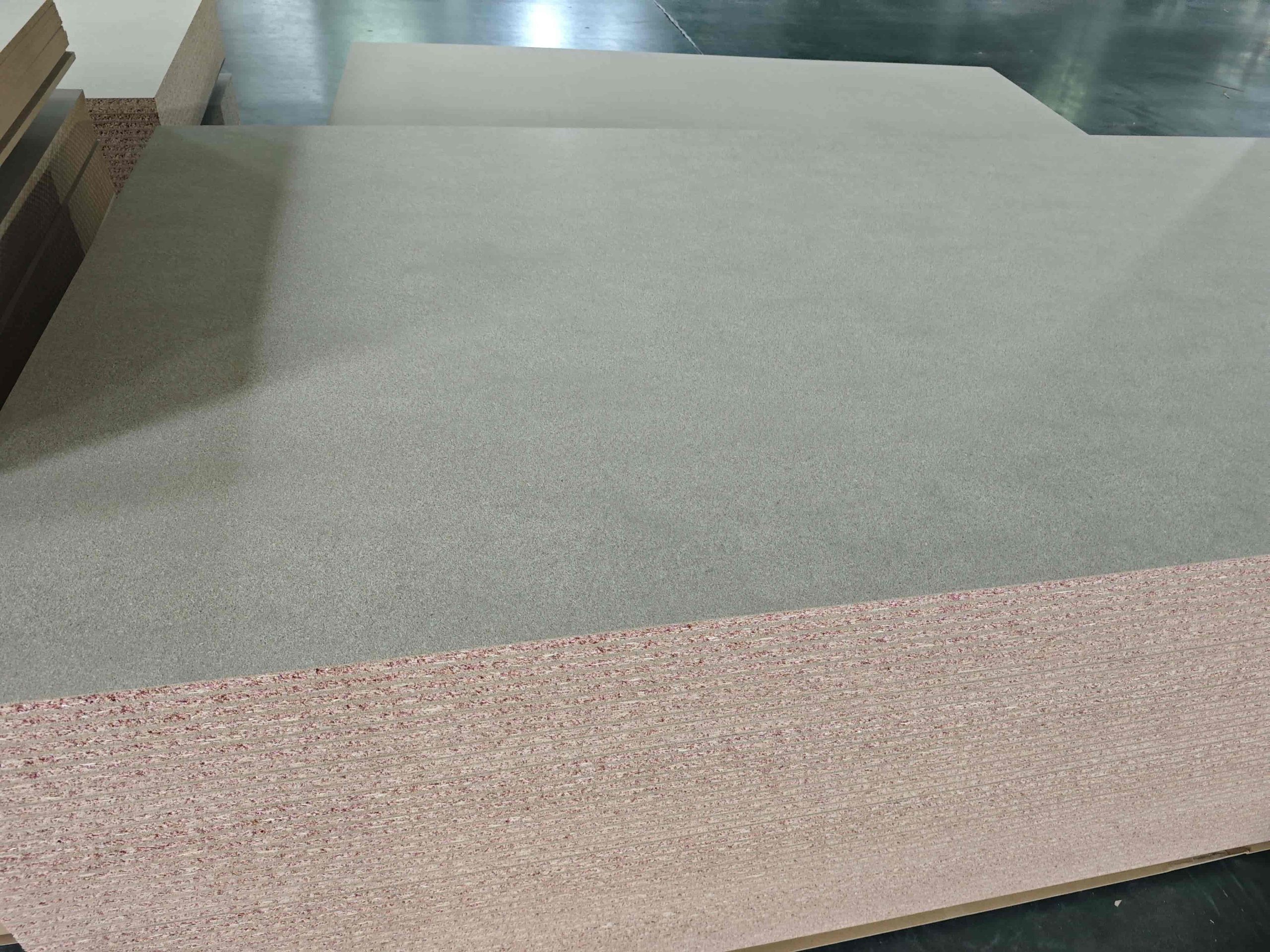
An identified cut sample helps you discuss the visible structure. Keep the whole sample and record where it came from. However, a phone image cannot verify species percentages, recovered content or chemical history. Use appearance to frame questions, not to issue a source certificate.
What Changes When the Board Will Become MFC?
For melamine-faced board, the paper and resin form the decorative surface system. The chipboard underneath remains a separate substrate. A successful decor match therefore does not approve a raw-material change. Keep the substrate reference beside the colour, texture and gloss reference.
Ask whether the quoted substrate is the actual range intended for facing. Approval should include the proposed finished construction when that is what you will resell. A raw sheet from one product range and a decorative sample from another do not together establish the production order.
Also keep the face finish separate from hidden-edge performance. A smooth face can help the product look saleable, but it does not resolve a fitting, machining or moisture question. Refer those requirements to the appropriate product specification instead of expecting the paper layer to compensate.
Compare Two Offers Without Creating a Timber Beauty Contest
The particleboard quotation guide covers the wider price comparison. For the raw-material part, ask each supplier to use the same information fields. That lets you see whether the price difference is a real product choice or simply missing information.
- Identify the panel range, intended component and raw or faced condition.
- Define any species or source claim in plain language.
- Ask what supporting information belongs to that exact product.
- Compare the required machining or assembly using representative material.
- Agree when a proposed product change needs approval.
Suppose the lower-priced offer includes selected recovered wood and the higher-priced offer states virgin wood. If both satisfy the agreed product and application requirements, the source difference alone need not decide the order. If your customer requires a particular sourcing claim, however, keep that requirement explicit and supported.
The opposite case matters too. A cheap offer with an undefined material stream may be difficult to resell under a promised specification. Ask for clarification before negotiating the last price reduction. A missing definition can cost more in customer explanations than it saves on a sheet.
Keep the Supply Promise Repeatable
Your customer normally wants a cabinet component that behaves as expected, not a new theory about feedstock each shipment. Keep the approved product, source claims and relevant sample record together. Allow workable sourcing flexibility where the agreement permits it, while requiring notification for changes that affect the supplied product or promises.
Do not require an unchanging forest source merely because it sounds precise. Equally, do not accept an unrestricted substitution clause when your customer depends on a named specification. Agree the boundary with the producer and make it understandable to the team placing repeat orders.
Momentimber can coordinate substrate matching, sample review and production follow-up for raw and melamine-faced particleboard. Our company introduction explains that supplier role. The aim is to make the material description useful to an order, rather than turning one attractive phrase into an unsupported quality guarantee.
Frequently Asked Questions
Related Reading
Sanded OSB for Furniture Still Needs a Finish Plan
OSB material reference only; sanding quality and the final finish need separate approval. Sanded OSB…
Plywood vs OSB for Crates Is More Than a Price Choice
Protected panel bundles are a supply-stage reference, not an approved design for a shipping crate….
Blockboard vs Finger Joint Board for Furniture Buyers
A visible timber-strip core does not make the finished panel the same as an exposed…

Synchronized Melamine Board Goes Beyond the Print
Woodgrain design reference only. A flat image cannot demonstrate EIR texture or alignment. Synchronized melamine…
Lightweight MDF vs Standard MDF for Furniture Parts
Panel appearance alone does not identify a lightweight MDF grade. Lightweight MDF can make a…
Film Faced Plywood Edge Sealing After Cutting
Film faced plywood edge sealing needs to follow the cutting and drilling plan. Factory edge…
Plywood for Melamine Facing Needs More Than Sanding
Plywood for melamine facing needs more than a smooth touch. Sanding can prepare a face,…
Cleaning Melamine Board Without Damaging the Finish
Cleaning melamine board should start with the supplied care instructions and a gentle method, not…
Particle Board Price: How to Compare Supplier Quotes
Compare the complete offered specification, not a single raw-material selling point.
P2 vs P3 Particleboard: What Cabinet Importers Should Specify
Keep the intended product grade separate from the wood-source description.
Raw Particleboard vs Melamine Faced Chipboard
Separate the chipboard substrate from its decorative surface and stock range.
Send your cabinet or furniture application, market, dimensions and raw or melamine-faced requirement. Momentimber can help compare substrate options without reducing the decision to a fresh-wood or recycled-wood label.