

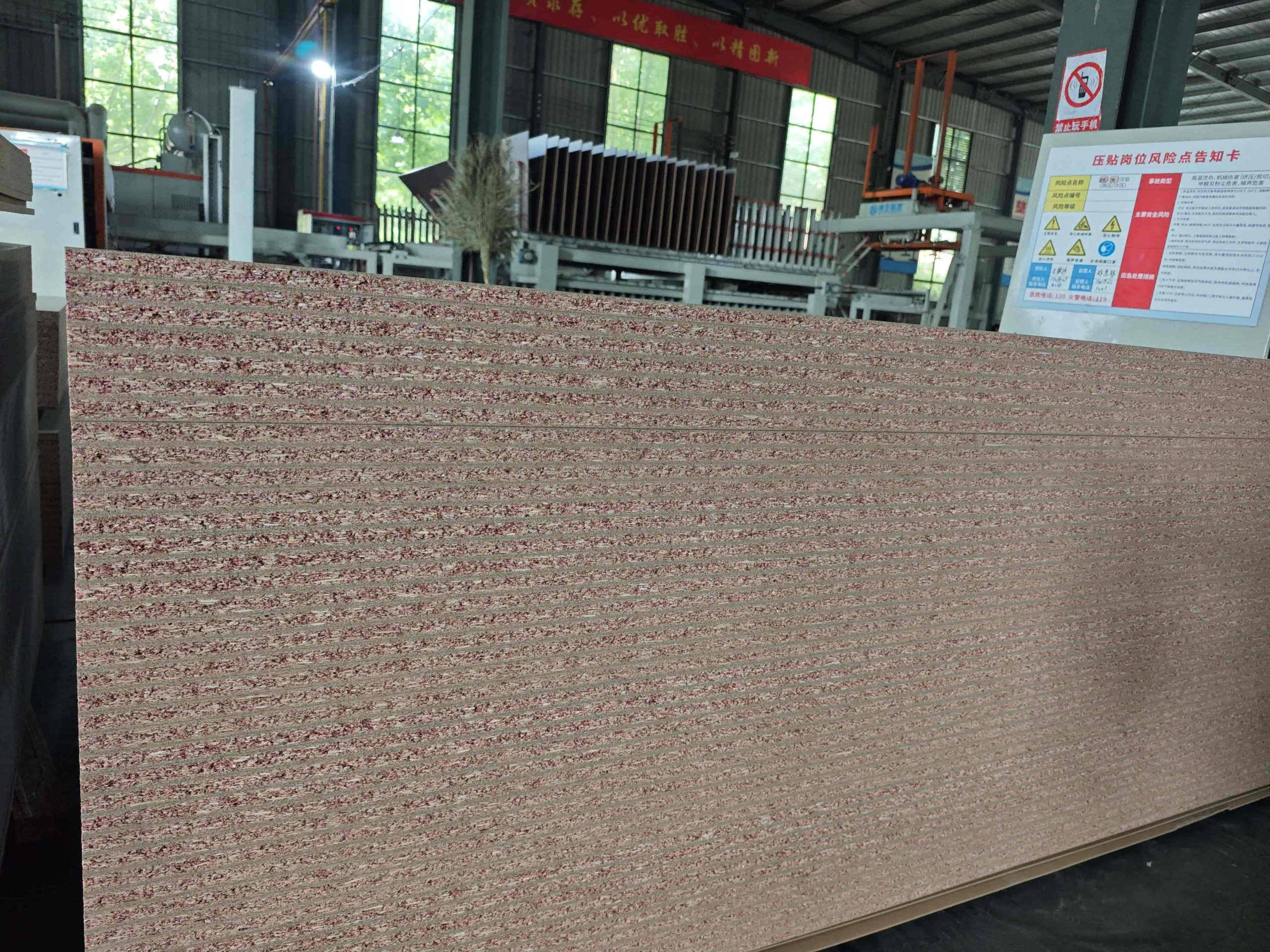
Particleboard worktops can have a chipboard core without being the same product as an ordinary cabinet sheet. A kitchen working surface needs an appropriate face, supporting board, edge detail and installation route. Do not substitute cabinet stock just because the decor matches. Start by identifying the complete worktop construction and the conditions it must handle.
For a buyer, the confusion often starts with a quotation that says laminated chipboard. That phrase may describe different supplied products. Before comparing prices, establish whether the seller means a cabinet panel, a substrate for local fabrication or a finished worktop.
Key takeaways
- A common particleboard core does not make two finished products interchangeable.
- Surface suitability and resistance to water entry are different decisions.
- Cut-outs and support must follow the complete worktop design, not thickness alone.
What Sits Inside a Particleboard Worktop
A particleboard substrate consists of particles bonded into a panel. It supplies the body underneath the decorative working face. The European Panel Federation particleboard overview identifies kitchen worktops among its applications. That is an application for suitable products, not an approval of any available cabinet sheet.
Think of a worktop as an assembly. Its broad face handles use and appearance. Its substrate supports that face. The front edge, trimmed ends and underside belong to the construction too. A useful drawing shows those positions rather than describing the whole product with the core material alone.
This is also different from compact laminate. That material has its own laminate body rather than an ordinary wood-particle core. A thin top shown in a catalogue should not become evidence that a much thinner chipboard panel can perform the same job.
The distinction matters when importing several product families together. Matching a door decor with a worktop decor can be useful for a kitchen range. It does not mean the door sheet and the horizontal working surface should use identical construction.
Particleboard Worktops Need the Right Decorative Surface
Direct melamine facing and bonded laminate
In a typical direct melamine-faced cabinet sheet, resin-impregnated decorative paper forms the specified face on the panel. MFC means melamine faced chipboard. It is a familiar furniture product, but its name alone does not establish suitability for every kitchen working surface.
HPL means high pressure laminate. The ICDLI material description explains it as a resin-and-paper laminate that can serve as a separate sheet bonded to a substrate. It is not simply another name for a direct melamine face. The actual product and grade still determine the intended use.
Our comparison of melamine and HPL surfaces gives the material background. Here the commercial question is narrower: what complete working surface does the quotation deliver? Do not infer heat, wear or impact suitability from the same colour reference.
Front edges do not describe every edge
A postformed front uses a suitable laminate formed around a prepared profile. A square-edged top follows a different front-edge detail. Neither description explains what happens at the end cut a fitter makes later. Record both the factory-supplied edge and the edges created downstream.
For example, two visually similar tops may reach a workshop with different end treatment still outstanding. One offer may include only the long front edge. Another may include additional finished ends. The extra work changes the comparison even if the visible laminate and overall dimensions match.
The Core Grade Cannot Seal a Sink Cut Out
The particleboard grade describes the substrate. It does not describe a complete waterproof joint or an installed sink detail. A more moisture-resistant core cannot take the place of the specified treatment at an exposed opening. Conversely, a good-looking laminate face cannot prove the suitability of the board underneath.
The P2 and P3 distinction helps buyers separate dry and humid interior substrate requirements. It should not become a universal claim that all worktops use P3 or that a grade name guarantees the finished kitchen. Follow the declared worktop construction and its application guidance.
Consider the route water would take in a hypothetical installation. A spill on an intact face differs from moisture sitting against an unprotected trimmed end. A joint near a sink creates another route. The relevant detail is where the liquid can reach the substrate, not just whether the top feels smooth.
The order should therefore distinguish the supplied protection from later fabrication. If the installer makes a new cut, the factory could not have treated that new edge in advance. Someone must own the specified finishing step before the assembly goes into service.
Thickness Support and Openings Work Together
The WPIF PanelGuide worktop selection guidance lists moisture resistance, surface quality, impact, dimensional stability, strength and stiffness as relevant considerations. It is a historical technical reference, not a current approval list. Its useful point is that the application requires several properties rather than one headline number.
A thick-looking front can also conceal a difference between the apparent edge depth and the actual supporting construction. Ask what the section contains. Do not use a front photograph to calculate the strength of the whole top or decide how far it can overhang.
Openings change the part after the original sheet leaves the factory. A sink or hob cut-out removes supporting material, and the surrounding cabinet layout determines where support remains. Keep the worktop drawing and the support arrangement together. Do not copy a safe-span claim from a different material or thickness.
For a small kitchen fabricator, the practical starting point is the actual plan: opening sizes, joint positions and bearing surfaces. These details can reveal that two nominally equal tops require different fabrication or reinforcement. Any load limit must come from the applicable product and design guidance, not a generic blog calculation.
Compare the Product Stages Before Comparing Prices
| Offer description | What the buyer receives | Work that may remain |
|---|---|---|
| Raw particleboard | A specified substrate panel | Surface bonding edges openings and finished-part validation |
| Melamine-faced cabinet sheet | Decorative sheet for its declared furniture use | Conversion and confirmation of suitability for the proposed component |
| Laminate-bonded worktop blank | Defined worktop face core and supplied edge construction | Site sizing cut-outs jointing and specified sealing |
| Fabricated worktop section | Agreed finished geometry and processing | Site installation connections and details outside the supply scope |
These rows describe buying stages, not a quality ranking. A raw board may be exactly right for a converter with an established production line. A small workshop without lamination equipment may need a much later stage. Compare what each business can actually finish economically.
Dimensions also change usable output. Suppose a plan requires one uninterrupted run of 2.8 metres. A 2.44-metre sheet cannot provide that run without a joint, regardless of its attractive square-metre price. This is a hypothetical planning example, not a recommended stock length. Joint appearance and worktop construction still need their own decisions.
Likewise, a narrow offcut may have little value in a market selling full kitchen runs. Compare cost per usable planned component where possible. Avoid treating every leftover square metre as equally saleable stock.
Different Buyers Need Different Decisions
An importer sourcing particleboard worktops should state whether the order is a substrate programme or a finished worktop programme. Those orders require different drawings and packing descriptions. A cabinet-board supplier may be appropriate for the first without automatically offering the second.
A distributor should separate cabinet sheets from kitchen worktop stock in item codes and sales language. Staff need a clear answer when a customer asks whether the matching board can go beside a sink. The answer should follow the declared application, not the fact that both products contain chipboard.
The downstream fabricator needs the actual opening, joint and edge instructions. Agree who performs each remaining operation before accepting a price comparison. This gives the fitter a usable product description instead of leaving the final construction to assumptions at the job site.
For Momentimber, the useful enquiry begins with raw or melamine-faced board options and the intended component. Clarify any separate laminate bonding or worktop-fabrication requirement. Treating those operations explicitly protects the buyer from ordering the right decor at the wrong supply stage.
The final question is not whether particleboard worktops can belong in a kitchen range. They can. The decision is whether the offered face, core, edges and remaining work form a suitable product for the kitchen you intend to supply.
Frequently Asked Questions
Related Reading
Sanded OSB for Furniture Still Needs a Finish Plan
OSB material reference only; sanding quality and the final finish need separate approval. Sanded OSB…
Plywood vs OSB for Crates Is More Than a Price Choice
Protected panel bundles are a supply-stage reference, not an approved design for a shipping crate….
Blockboard vs Finger Joint Board for Furniture Buyers
A visible timber-strip core does not make the finished panel the same as an exposed…

Synchronized Melamine Board Goes Beyond the Print
Woodgrain design reference only. A flat image cannot demonstrate EIR texture or alignment. Synchronized melamine…
Lightweight MDF vs Standard MDF for Furniture Parts
Panel appearance alone does not identify a lightweight MDF grade. Lightweight MDF can make a…
Film Faced Plywood Edge Sealing After Cutting
Film faced plywood edge sealing needs to follow the cutting and drilling plan. Factory edge…
Plywood for Melamine Facing Needs More Than Sanding
Plywood for melamine facing needs more than a smooth touch. Sanding can prepare a face,…
Cleaning Melamine Board Without Damaging the Finish
Cleaning melamine board should start with the supplied care instructions and a gentle method, not…
P2 vs P3 Particleboard for Cabinets
Understand why a substrate grade is not a complete component specification.
Raw Particleboard vs Melamine Faced Chipboard
Separate raw substrate supply from decorative cabinet-sheet supply.
Melamine vs HPL Board Surfaces
Compare the surface systems before using matching decors as a substitution rule.
Need raw or melamine-faced particleboard for a defined furniture component? Send the application, sheet dimensions, surface requirement and local conversion plan. Momentimber can discuss suitable board options. A finished HPL worktop or specialist fabrication programme requires separate scope and availability confirmation.