

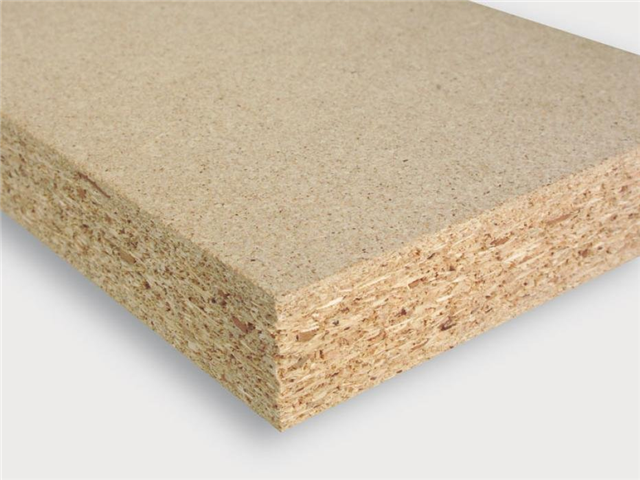
Sanded vs unsanded particleboard describes the state of the base board before its next operation. Sanding removes surface material. Calibration brings the board toward an agreed finished thickness. These jobs can overlap, but they are not identical. Neither label alone proves that the board is ready for the buyer’s melamine press or other facing line.
For an importer, the distinction decides who completes the preparation and pays for the lost material. For a laminator, it affects the surface entering the line. A low raw-sheet price can therefore hide extra local work. First identify what the offered board includes, then compare it with the process you actually intend to run.
Raw Does Not Mean Unsanded
Particleboard, also called chipboard, contains wood particles bonded into a panel. Raw usually distinguishes an undecorated board from a decorative faced board. A raw board may already be sanded. Conversely, an unsanded offer describes an unfinished preparation stage rather than a different wood species or a complete performance grade.
As-pressed describes the panel after consolidation in the press, before the stated later preparation. Sanded describes abrasive treatment of its surfaces. Calibrated describes the thickness result being pursued. Ask which of those descriptions applies to the delivered sheet; a supplier can use more than one of them for the same product.
The EPA process description for particleboard manufacture places cooling and sanding or trimming after pressing and before further finishing. That sequence helps locate the operation. It is background on production, not a recipe for a current line or a guarantee that every offered panel has passed the same preparation steps.
Why the Surface Needs Preparation
A decorative face lies over the substrate surface. Local high areas, depressions or sanding marks can therefore matter to the finished appearance and contact with the facing. Preparing the surface aims to provide the condition required by the chosen system. A face that merely looks pale and clean in a photograph has not demonstrated that condition.
A surface can also feel smooth while remaining uneven across the sheet. Smoothness describes small-scale texture; flatness concerns the larger form. Thickness variation is another measurement. These attributes interact in processing, but one convenient hand-feel check cannot replace all three.
The three-layer particleboard guide explains fine surface particles and the coarser internal core. Sanding works with that existing construction. It does not create a new fine-particle face of unlimited depth, and it cannot turn any particle mix into the same facing substrate.
Calibration and Finish Sanding Have Different Jobs
A thickness-calibration operation removes material to approach the specified finished thickness and its permitted variation. Finish sanding addresses the surface required for the next operation. A production line may combine stages, but the buyer should still state the dimensional result and the surface result separately.
Sanding grit describes the abrasive used, not the size of the wood particles forming the face. Those are two different specifications. A finer abrasive cannot add a missing fine-particle layer, and a fine-particle board does not explain which abrasive treatment it received. Keep the underlying face construction and the finishing operation separate when discussing the supplied surface with a producer or laminator.
For example, two sheets may both be described as sanded while having different finished thickness variation or visible abrasive marks. That does not automatically make either defective. It means the word sanded is incomplete until connected to the agreed product and use.
| Supply description | What it tells a buyer | What still needs agreement |
|---|---|---|
| Raw | No specified final decorative face | Sanding state and substrate grade |
| Unsanded or as-pressed | Preparation work remains | What work, by whom and to what result |
| Sanded | Abrasive treatment was included | Finished thickness and usable face |
| Calibrated | Thickness control was a process aim | Tolerance and measurement basis |
| Facing-ready | A claimed match to a next operation | The actual facing route and sample approval |
Treat facing-ready as a claim with a context, not a universal grade. A board prepared for one laminator may need different handling or preparation for another process. Keep a reference to the proposed finish rather than ordering a general smooth board and hoping the rest will fit.
More Material Removal Is Not Always Better
Sanding consumes panel thickness. Removing extra material can change the delivered thickness and what remains of the surface zone. It also adds processing and waste. The sensible aim is the agreed result with a suitable board, not maximum removal or a perfectly uniform colour at any cost.
It is especially unhelpful to repair an unsuitable base board by repeatedly sanding it without a finished-thickness plan. Even if the face looks cleaner, the sheet may no longer match the ordered component. Where the proposed preparation changes, reassess the finished panel rather than accepting its original nominal thickness as the answer.
Our particleboard thickness-tolerance guide follows that dimension into cabinet fit. The same logic applies before facing: state the relevant supplied thickness, the finished target and the process stage where each is measured. Do not assume an unspecified sanding allowance will take care of the difference.
What Sanding Cannot Change Inside the Board
The European Panel Federation overview of particleboard describes wood particles formed with adhesive under heat and pressure. Sanding is a later surface operation. It does not rebuild the internal particle arrangement or binder system. Keep the original substrate properties in the comparison even when two sheets have received a similar abrasive finish.
A buyer should therefore separate a surface-preparation problem from a material-selection problem. If the board is unsuitable for the intended component or service, a neater face does not solve that choice. Equally, a suitable declared substrate can still require proper preparation before it receives its decorative face.
Sanded vs Unsanded Particleboard in a Facing Order
A melamine-faced board uses resin-impregnated paper as the decorative surface system. A bonded sheet laminate or a coating uses a different route. Do not transfer the successful preparation from one system to another without checking the complete combination. The base board, facing and equipment need to work together.
Dust remaining after preparation is another part of that handover. Ask how the board will reach the next operation in the agreed condition. A sample cleaned specially for approval is not a useful reference if ordinary deliveries enter production in another state. Keep the preparation and handling description with the sample.
There is no universal grit number or press setting in this buying guide. A suitable specification comes from the actual board and facing process. If the laminator already has a successful combination, begin with that reference and identify what a proposed new raw-board offer changes.
A Lower Sheet Price Can Shift Work Downstream
Suppose a hypothetical unsanded offer saves two cost units per sheet. If local preparation, extra handling and material loss cost three units per accepted sheet, it is already dearer before any lost production time. These are illustrative units, not a price claim. The comparison exposes where the remaining work sits.
Use the same denominator for both offers: an accepted prepared substrate or a completed faced sheet. Include any difference in actual yield. A workshop with spare, capable preparation equipment may reach a different answer from a distributor with no sanding line. That is a business-model difference, not a contradiction.
The calculation should also reflect order size and repeatability. A small trial may be manageable locally while a regular full-container programme ties up the finishing line. Conversely, buying a specially prepared state may make little sense if the customer immediately performs another planned calibration step.
Keep Measurements and Appearance on Separate Records
The public scope of EN 324-1 addresses panel thickness, width and length measurement. It does not provide a universal surface-finish approval. Record the dimensional basis alongside a separate description of the facing surface and its representative sample. Do not ask a thickness measurement to prove decorative suitability.
Practical review can stay straightforward. Identify the supplied stage, measure at agreed locations and run a representative facing trial with the intended operator. Keep the resulting sample and short process record. Laboratory work is not a prerequisite for every comparison; the first need is a repeatable practical reference.
Make the Preparation Handover Clear
A sanded vs unsanded particleboard comparison should end with a clear preparation handover. The importer needs to know what arrives ready for use. A distributor should describe any remaining work accurately. The downstream laminator should state the incoming condition its established process needs, including the final thickness reference.
Momentimber can coordinate specification matching, sample review and production follow-up across raw and melamine-faced particleboard options. Our company introduction describes that supplier-service role. A clear handover between the board producer and the facing operation makes the offer easier to compare and the approved result easier to repeat.
Frequently Asked Questions
Related Reading
Sanded OSB for Furniture Still Needs a Finish Plan
OSB material reference only; sanding quality and the final finish need separate approval. Sanded OSB…
Plywood vs OSB for Crates Is More Than a Price Choice
Protected panel bundles are a supply-stage reference, not an approved design for a shipping crate….
Blockboard vs Finger Joint Board for Furniture Buyers
A visible timber-strip core does not make the finished panel the same as an exposed…

Synchronized Melamine Board Goes Beyond the Print
Woodgrain design reference only. A flat image cannot demonstrate EIR texture or alignment. Synchronized melamine…
Lightweight MDF vs Standard MDF for Furniture Parts
Panel appearance alone does not identify a lightweight MDF grade. Lightweight MDF can make a…
Film Faced Plywood Edge Sealing After Cutting
Film faced plywood edge sealing needs to follow the cutting and drilling plan. Factory edge…
Plywood for Melamine Facing Needs More Than Sanding
Plywood for melamine facing needs more than a smooth touch. Sanding can prepare a face,…
Cleaning Melamine Board Without Damaging the Finish
Cleaning melamine board should start with the supplied care instructions and a gentle method, not…
Three Layer Particleboard: Surface vs Core Quality
See how face particles and the internal core perform different jobs.
Particleboard Thickness Tolerance: Why Cabinet Parts Stop Fitting
Carry the finished thickness into the component and assembly requirement.
Melamine Paper and Resin: How They Affect Board Quality
Continue from the prepared substrate to the decorative facing system.
Send the intended facing process, finished panel thickness, dimensions and a representative substrate or finished-board sample. Momentimber can coordinate suitable raw or melamine-faced particleboard sourcing and clarify which preparation stages are included in the offer.