

Blockboard sheet sizes should follow the furniture parts you need, not a rule that the largest sheet is the best value. A longer format may allow a tall side or door to remain one piece. It can also leave more offcut, require different handling or limit the available facing. Start with the finished part and work back to a confirmed sheet format.
For an importer, this turns a simple 4×8 or 4×10 enquiry into a commercial decision. The useful question is how many approved parts arrive from each purchased sheet, and whether the customer can process that sheet. A cheaper square metre is not helpful if the required component cannot be cut from it.
What Is Included in a Blockboard Sheet
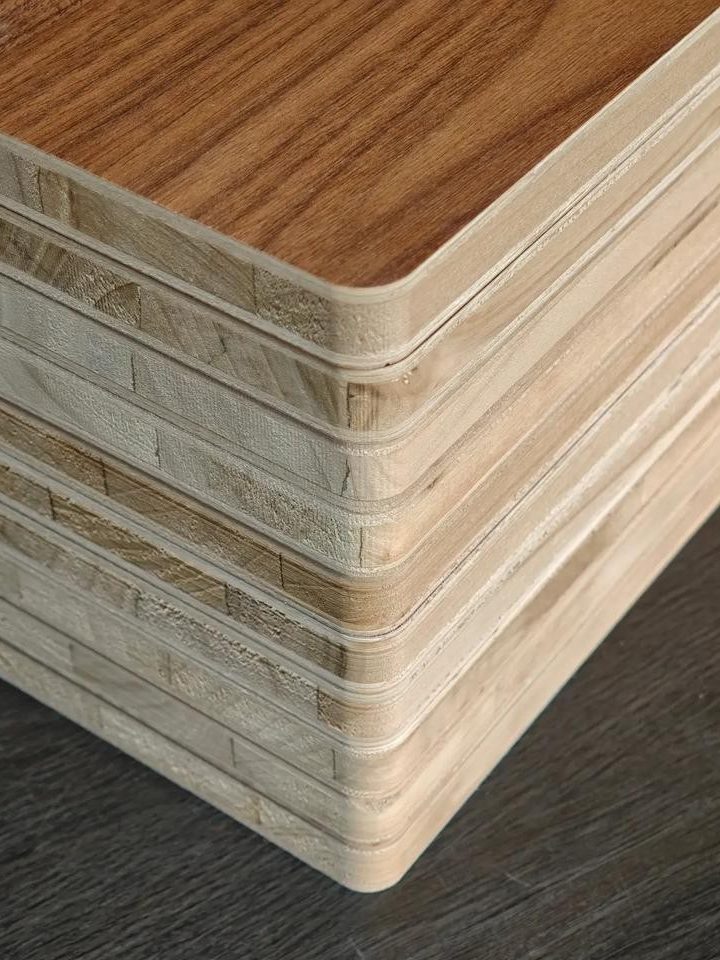
A blockboard panel has a timber-strip core with the specified supporting and facing layers. Those layers make a sheet that can be supplied raw or with a decorative surface. Its outside length and width are not the same dimensions as a finished cabinet side, shelf or door.
The FAO description of strip-core blockboard explains the basic material arrangement. For this buying decision, you do not need to choose every internal layer first. You do need to keep the agreed construction unchanged while comparing sizes. A larger sheet with a different core or support system is not simply a longer version of the approved product.
A finished part is the item after the agreed cutting and any further sizing operations. Write down whether a drawing gives the sawn blank, the finished edged component or the completed assembly dimension. If the workshop needs material for a later operation, that allowance must be part of the layout rather than discovered after delivery.
Trade Names Are Not the Final Dimensions
Labels such as 4×8, 4×9 and 4×10 are convenient enquiry language. Do not treat the label as a substitute for the supplier-confirmed length and width in millimetres. Regional naming, nominal size and the supplied finished state can differ. Put one agreed dimensional description on the purchase order.
For example, this article later compares sheets declared as 1220 x 2440 mm and 1220 x 3050 mm. Those are inputs for that example, not a promise that every board with the same trade label has exactly those dimensions. Ask what is delivered and what tolerance applies.
The public scope of EN 324-1 addresses measurement of panel thickness, width and length. It provides a useful distinction between a measured dimension and a trade name. It does not give you a universal cutting allowance for every mill, surface or furniture order.
Usable Blockboard Sheet Sizes Start After Trimming
Perimeter trimming removes the amount required to establish the agreed cutting reference and usable edges. Saw kerf is the material removed by the blade. Both consume space. A layout based only on dividing the outside sheet area by the component area can therefore overstate the number of pieces.
Ask the cutting shop to show its intended trim and kerf in the layout. A 10 mm trim per edge and a 4 mm kerf may be convenient assumptions for a calculation, but they are not industry acceptance limits. The actual equipment, supplied edges and next operation determine the working values.
Also mark whether small defects or surface exclusions affect the usable area. This is especially relevant to a visible faced component. A sheet can meet its overall dimensions while a particular layout still places an unwanted area on the visible part. Decide what is acceptable before counting every rectangle as saleable output.
A simple width check shows why this matters. Suppose a hypothetical trimmed sheet is 1200 mm wide and the blanks are 400 mm wide. Three blank widths total 1200 mm, but two assumed 4 mm separating cuts bring the requirement to 1208 mm. That row does not fit. This is not a full nesting calculation; it shows why the workshop must allow for the cuts between parts before approving a quantity.
Direction can remove an apparent saving
The blockboard core-direction guide explains why rotating a part is not always acceptable. On a melamine-faced panel, the printed woodgrain may impose a separate direction. Keep both arrows on the proposed layout so the calculation produces the approved part, not merely a rectangle of the right size.
When a Longer Sheet Makes a Real Difference
Consider a hypothetical 590 x 2600 mm sawn blank. Assume its required orientation keeps 2600 mm along the sheet length. The two example sheets are 1220 x 2440 mm and 1220 x 3050 mm. Allow 10 mm around each outside edge and a 4 mm kerf between two blanks. These are illustrative planning inputs only.
| Calculation | 1220 x 2440 mm sheet | 1220 x 3050 mm sheet |
|---|---|---|
| Usable rectangle after assumed trim | 1200 x 2420 mm | 1200 x 3030 mm |
| Two 590 mm widths plus one kerf | 1184 mm fits within 1200 mm | 1184 mm fits within 1200 mm |
| Required 2600 mm blank length | Does not fit within 2420 mm | Fits within 3030 mm |
| Result in this specified layout | No such full-length blank | Two full-length blanks |
Here the longer sheet solves a real component problem. Joining shorter pieces would create a different component and needs separate design approval. The right comparison is therefore a confirmed long sheet against another approved way of making the required part, not a short sheet that cannot produce it.
Now consider shorter parts that already nest well on the smaller sheet. A longer sheet might add no extra complete row of parts. In that case it can increase the purchased area without increasing the useful piece count. Run the actual cutting plan before paying for the additional length.
Compare Cost per Usable Part
A simple starting calculation is total attributable cost divided by the number of accepted parts. Include the sheet purchase, relevant freight allocation, cutting and handling. Keep recoverable offcut separate from immediate waste, and use an offcut credit only when the material has a realistic further use.
For a hypothetical comparison, a sheet costing 60 cost units and yielding two accepted blanks begins at 30 units per blank before additional allocated costs. Another sheet at 50 units yielding no required full-length blank is not the cheaper source for that component. The example is arithmetic, not a current market quotation.
For repeat production, extend the comparison to the complete cutting list. A layout that looks efficient for one tall panel may leave the shelves or partitions poorly matched. The workshop may combine useful parts across the sheet, provided their construction and direction requirements are compatible.
Check What the Larger Format Changes Downstream
For melamine-faced boards, confirm that the proposed size is available with the required substrate, decor and finish. A producer’s ability to supply a long raw core does not establish that the completed faced construction is available on the same terms. Keep the whole product in the enquiry.
The cutting shop must also accept the format. Review the saw or CNC working area, loading arrangement, stacking support and available handling space. A larger sheet that needs an additional reduction cut may still be useful, but that operation belongs in the plan and price.
Packing and container layout need the confirmed bundle dimensions. Longer packs can change support positions, forklift access and the sequence for unloading. Do not derive a loading quantity from nominal sheet area alone. Confirm the actual pack and handling arrangement with the shipment plan.
Stock the Format Your Customers Can Use
An importer serving a confirmed furniture project can order a longer format against the approved component list. A distributor serving many small workshops may prefer a familiar general-purpose size and offer longer formats for specific orders. These are different purchasing models, even when both customers ask for the same thickness.
Our blockboard weight guide covers a separate handling question. Keep sheet size, weight and construction visible together when discussing a different format. A buyer should not need to reconstruct the product from several unrelated messages.
For a repeat order, retain the dimensions, cutting-list revision and directional requirements that made the first order workable. If demand changes, recalculate rather than assuming the previous large sheet remains the best choice. A project-specific saving can become slow stock when the project mix changes.
Momentimber can coordinate confirmed raw or melamine-faced blockboard options with sample review and production follow-up. Our company introduction explains that supplier-service role. Send the part dimensions before asking for the biggest available sheet; they are what make a format useful.
Frequently Asked Questions
Related Reading
Sanded OSB for Furniture Still Needs a Finish Plan
OSB material reference only; sanding quality and the final finish need separate approval. Sanded OSB…
Plywood vs OSB for Crates Is More Than a Price Choice
Protected panel bundles are a supply-stage reference, not an approved design for a shipping crate….
Blockboard vs Finger Joint Board for Furniture Buyers
A visible timber-strip core does not make the finished panel the same as an exposed…
Synchronized Melamine Board Goes Beyond the Print
Woodgrain design reference only. A flat image cannot demonstrate EIR texture or alignment. Synchronized melamine…
Lightweight MDF vs Standard MDF for Furniture Parts
Panel appearance alone does not identify a lightweight MDF grade. Lightweight MDF can make a…
Film Faced Plywood Edge Sealing After Cutting
Film faced plywood edge sealing needs to follow the cutting and drilling plan. Factory edge…
Plywood for Melamine Facing Needs More Than Sanding
Plywood for melamine facing needs more than a smooth touch. Sanding can prepare a face,…
Cleaning Melamine Board Without Damaging the Finish
Cleaning melamine board should start with the supplied care instructions and a gentle method, not…
Blockboard Core Direction: How It Changes Cutting Plans and Door Stability
Check whether the intended part may be rotated within a sheet.
Blockboard Density and Weight: Why Two 18 mm Sheets Differ
Add actual panel weight to the handling and loading discussion.
How Woodgrain Direction Changes Melamine Board Yield
Keep the visible decorative direction in the layout.
Send the finished-part list, required thickness, core direction, decor reference and expected order quantity. Momentimber can help compare a confirmed blockboard format with the actual production requirement.