

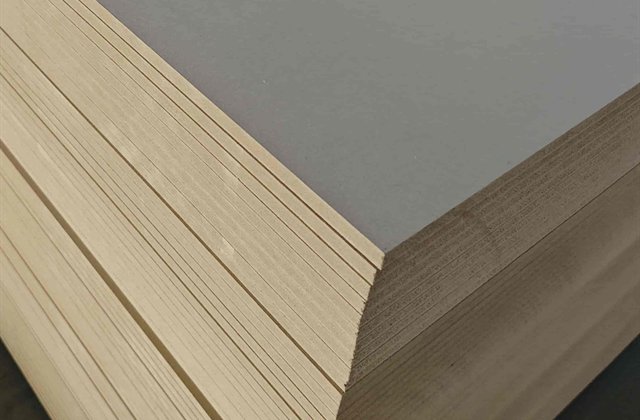
MDF grain direction is not the same as grain in a solid wood board. Raw MDF contains prepared wood fibres rather than a continuous timber grain running from one end to the other. You can often consider rotating a raw part on the cutting plan. A directional decorative face may prevent that rotation.
What the Fibres Actually Mean
MDF is medium-density fibreboard. Manufacturers prepare wood fibres, distribute them into a mat and consolidate the panel. The Natural Resources Canada MDF overview describes this fibre-based structure. It differs from slicing a board from a tree and retaining its continuous grain.
Do not turn that distinction into a stronger claim than it supports. MDF is not guaranteed to behave identically at every point or in every direction. Its broad face and cut edge also expose different parts of the panel. The actual product and component still matter.
MDF Grain Direction and the Decorative Face
A melamine-faced MDF sheet can carry a woodgrain print. Those visible lines belong to the decorative facing. They are not the timber grain of the fibreboard underneath. A plain-colour face can have other appearance details to agree as well.
The EPF guidance on melamine surfacing treats decorative paper direction as part of the facing process. For furniture, the buyer should state how the visible pattern runs on each part. Our woodgrain cutting-yield guide develops that layout question.
When Can the Part Rotate
Start with the actual part, not just the rectangle of stock. Rotation may help a cutting layout, but it cannot change the finished dimensions or the agreed appearance. Nor should it bypass a component requirement in the drawing.
| Supplied product | Check before rotating | Practical decision |
|---|---|---|
| Raw MDF | Drawing and any product restriction | Rotation may be an option |
| Woodgrain-faced MDF | Visible pattern and matching parts | Follow the agreed direction arrow |
| Plain decorative face | Texture, finish and face identity | Confirm appearance before allowing rotation |
Consider a plain raw rectangle that will receive a later opaque finish. Its layout may allow a quarter-turn. Now consider two woodgrain cabinet doors beside one another. A quarter-turn may put one pattern across the door and the other along it. The MDF substrate can be the same while the appearance decision differs.
Keep Material and Drawing Instructions Separate
An importer should describe the MDF and the finish as separate items. A distributor should keep a directional decor distinct from an unrestricted raw sheet. The workshop then needs one clear layout instruction: whether each part may rotate, and which face must remain visible.
A direction arrow without a label can cause confusion. State whether it refers to the decor, a component requirement or another agreed restriction. Do not add a timber-style grain arrow to raw MDF merely because the sheet has a longer side. Conversely, do not remove a decor arrow because the substrate is fibreboard.
Momentimber can help keep those material and surface descriptions consistent when discussing sourcing options. The aim is a useful cutting instruction, not a claim that every MDF sheet can replace every other panel in either orientation.
Frequently Asked Questions
Related Reading
Sanded OSB for Furniture Still Needs a Finish Plan
OSB material reference only; sanding quality and the final finish need separate approval. Sanded OSB…
Plywood vs OSB for Crates Is More Than a Price Choice
Protected panel bundles are a supply-stage reference, not an approved design for a shipping crate….
Blockboard vs Finger Joint Board for Furniture Buyers
A visible timber-strip core does not make the finished panel the same as an exposed…
Synchronized Melamine Board Goes Beyond the Print
Woodgrain design reference only. A flat image cannot demonstrate EIR texture or alignment. Synchronized melamine…
Lightweight MDF vs Standard MDF for Furniture Parts
Panel appearance alone does not identify a lightweight MDF grade. Lightweight MDF can make a…
Film Faced Plywood Edge Sealing After Cutting
Film faced plywood edge sealing needs to follow the cutting and drilling plan. Factory edge…
Plywood for Melamine Facing Needs More Than Sanding
Plywood for melamine facing needs more than a smooth touch. Sanding can prepare a face,…
Cleaning Melamine Board Without Damaging the Finish
Cleaning melamine board should start with the supplied care instructions and a gentle method, not…
MDF Wood Fibres and Tree Species
Understand the fibre material before comparing a species name.
How MDF Is Made
Follow fibre preparation, forming and pressing into a finished sheet.
Woodgrain Direction and Melamine Cutting Yield
Continue to directional decor and furniture part layout.
Send the MDF part drawing, required finish and any direction arrow. Momentimber can help clarify raw or melamine-faced board options before you fix the order and cutting layout.