

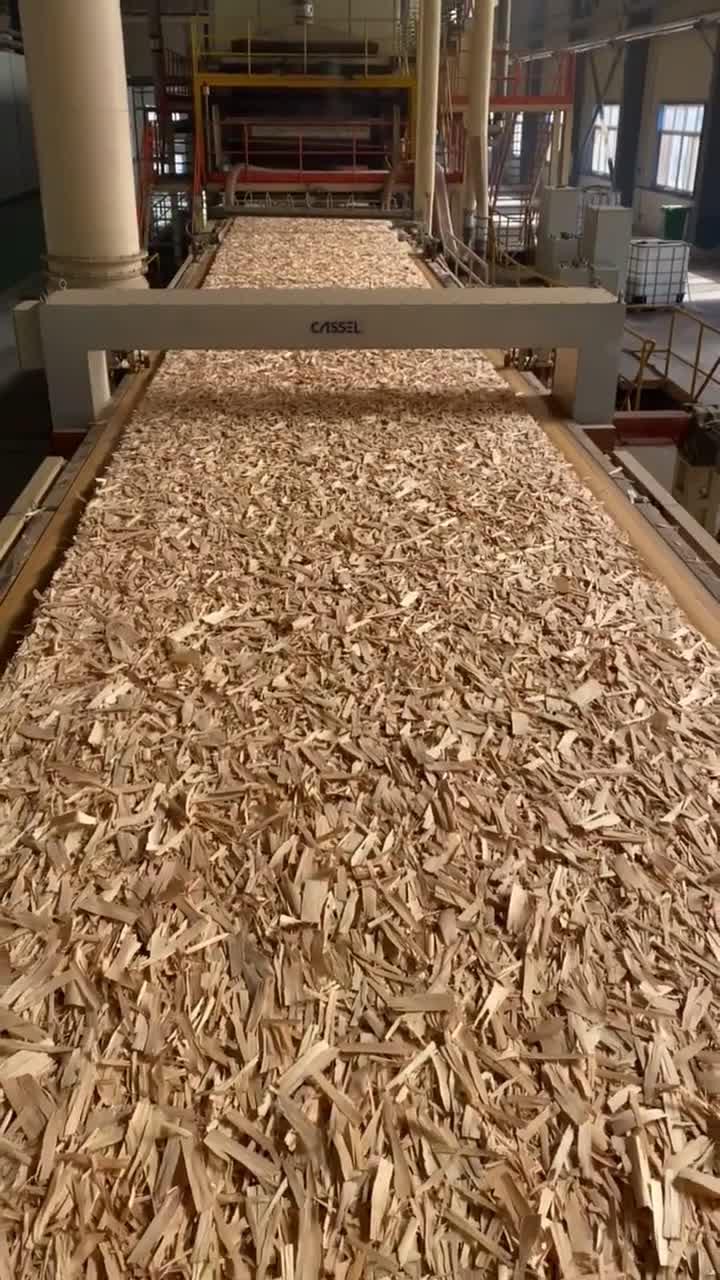
Particleboard binders are the adhesives that turn loose wood particles into a usable board. UF, MUF and pMDI are three binder families you may see in quotations. They influence the bond inside the panel, but they do not describe the decorative surface or tell you everything about the finished board.
This distinction matters when two suppliers offer apparently similar cabinet boards and justify a price difference with the glue name. Before deciding whether the extra cost is useful, you need to know what each material does, which application it suits and what the proposed panel actually changes.
What Particleboard Binders Do Inside the Panel
A particleboard substrate is made from prepared wood particles. The producer distributes binder through the particles, forms them into a mat and consolidates that mat in a press. As the adhesive cures, it develops the bonds that hold neighbouring particles together. The binder becomes part of the board rather than a visible layer on its face.
Curing means the adhesive develops its final bonded state through its intended reaction and processing conditions. It is not simply the outside of a wet sheet drying. The producer must coordinate adhesive distribution, particle condition and pressing so that the panel bonds adequately through its thickness.
The USDA Wood Handbook discussion of wood bonding explains why adhesive, wood and manufacturing conditions work together. For a buyer, that gives a useful starting point: a resin family helps explain a panel, while the panel itself remains the product you are selecting.
A layered particleboard may also use different particle sizes or binder arrangements in its faces and middle. Therefore, a supplier saying pMDI board should explain whether that statement describes the whole substrate or a particular layer. You do not need a confidential recipe to get a clear product description.
UF Is an Established Choice for Dry Interior Boards
UF means urea-formaldehyde. It is a thermosetting resin family: once properly cured, it forms a bonded structure rather than a glue that is intended to melt and flow again. UF is widely associated with interior particleboard and furniture substrates. It is a familiar starting point for conventional dry-use panel offers.
Its practical attraction is that a producer can make a suitable interior panel using an established adhesive and production system. For an ordinary wardrobe side or an office-cabinet component used in dry conditions, a correctly specified UF-bonded product may meet the requirement without buying a different resin label.
The limitation is sustained heat and moisture exposure, which can weaken UF bonds. That matters when an indoor furniture requirement quietly becomes a wet-service requirement. A board suitable for a dry bedroom should not be assumed suitable beside persistent leaks merely because the visible faces are covered.
MUF Changes the Resin Formulation With Melamine
MUF means melamine-urea-formaldehyde. It combines melamine with the urea-formaldehyde resin system. Here, melamine is part of an adhesive formulation inside the substrate. It is not the printed decorative paper that makes a board look like oak or plain white.
Melamine modification can improve moisture-related bond performance. A USDA-hosted study of MUF-bonded particleboard found that changing the formulation affected internal bond and moisture-related panel results. The important point is that formulation matters. A MUF name by itself does not specify one fixed level of performance.
This makes MUF worth discussing when a supplier proposes a board for a more demanding interior exposure. However, ask which panel grade and product properties the offer provides. A resin change should have a purpose in the completed board, rather than serving as an unexplained upgrade in the quotation.
It is also unhelpful to rank every MUF board above every UF board. Wood preparation, adhesive application and pressing still affect the result. The name identifies the family; it does not show whether a particular sheet was manufactured well or approved for the component you plan to sell.
pMDI Is a Different Adhesive Family
pMDI means polymeric methylene diphenyl diisocyanate. It belongs to the isocyanate adhesive family rather than the UF or MUF resin family. It can form strong, durable bonds with wood. It may appear in offers where the producer wants a different bonding system or a particular product declaration.
Unlike UF and MUF, a pMDI binder does not need added formaldehyde as a resin ingredient. That can make it relevant to a customer requirement concerning the binder. It does not prove that the finished panel releases nothing. Wood, other ingredients and subsequent facing operations remain part of the supplied product. Keep the claim tied to that product and its supporting information.
For a distributor, this distinction affects how the product is sold. A binder description can help identify a product range, but it should not become an unsupported zero-emission or waterproof promise on a stock label. Describe the confirmed board rather than extending the resin claim to the entire furniture assembly.
How the Three Particleboard Binders Compare
The comparison below shows why these particleboard binders enter different purchasing discussions. It is a guide to the material choice, not a price ranking or a replacement for a board specification.
| Binder | Practical reason to consider it | Important limit |
|---|---|---|
| UF | An established option for specified dry interior furniture panels. | Do not transfer dry-use suitability to prolonged wet exposure. |
| MUF | Melamine modification may support improved moisture-related bond performance. | The formulation and declared panel grade still need identification. |
| pMDI | A different bonding system, including offers addressing added-formaldehyde requirements. | The binder name does not establish zero emissions or a complete board grade. |
These are not three steps on a universal quality ladder. If a quotation changes binder, density and facing at the same time, it offers a different panel package. Compare the complete products before attributing a price or machining difference to one ingredient.
Choose the Board for the Service Conditions
Dry interior furniture
For wardrobe carcasses, office storage or other dry interior components, first establish the panel properties the furniture needs. A suitable conventional board may be enough. Spending more on the binder has little commercial purpose if it does not improve an agreed requirement or solve an identified supply problem.
Interiors with a greater moisture risk
For a kitchen or another interior with possible humidity or intermittent moisture, specify the required panel grade and exposure. Our P2 and P3 particleboard guide explains that product-level distinction. Consider an appropriate MUF- or pMDI-bonded offer if its declared properties match that need. Neither name alone approves leaks or permanent wet use.
A customer requirement about the binder
Sometimes the customer specifically requires a named bonding system or an applicable product declaration. Put that requirement in the enquiry at the start. Ask the supplier to identify the proposed product and confirm the scope of the statement. Avoid buying a generic upgrade first and trying to make it fit the customer requirement later.
A Melamine Face Is a Separate Material Decision
In melamine-faced boards, resin-impregnated decorative paper forms the surface. The particleboard binder bonds the particles below it. One helps define the exposed finish; the other helps create the substrate. This is why a white melamine face does not reveal whether the core uses UF, MUF or pMDI.
The melamine paper and resin article covers that surface system. Keep the two descriptions together on an order: the specified particleboard product plus the specified facing. That gives the downstream workshop a more useful identity than melamine glue board.
What Each Supply Chain Buyer Should Decide
An importer should connect the choice of particleboard binders to the destination and intended furniture use. The order needs the substrate reference, supplied faces, dimensions and relevant declarations. If a binder statement is part of the sales promise, confirm which layers it covers and whether it remains the same on repeat orders.
A distributor should keep different board ranges distinguishable in the warehouse. Two white-faced sheets may look alike while being approved for different uses. Label the product reference and grade clearly, and pass the confirmed use to customers. Do not rely on a salesperson remembering what the premium glue was supposed to mean.
A furniture maker needs to know whether the board works with the actual cutting, edging and hardware arrangement. A representative component trial can reveal fit and processing differences without a laboratory. Formal property claims still need appropriate product evidence; an informal workshop comparison answers a different question.
Compare a substitution without changing the question
Consider a hypothetical distributor buying a dry-use wardrobe board. An alternative supplier offers MUF with a different density and surface. Ask first whether both offers meet the same wardrobe specification. Then compare the supplied component, finish and total cost. Otherwise, the discussion becomes a debate about glue while several other purchasing decisions change unnoticed.
On the enquiry, state the component, intended conditions, finished dimensions, required faces and any specific product or binder requirement. Agree how a substitution will be approved. You usually need this clear purchasing record more than an unexplained glue percentage or a factory formulation.
Momentimber can help match raw or melamine-faced particleboard, coordinate samples and follow production against the agreed item. Our company introduction explains this supplier-service role. The aim is a board that works for the customer’s use and can be ordered again with the same understood specification.
Frequently Asked Questions
Related Reading
Sanded OSB for Furniture Still Needs a Finish Plan
OSB material reference only; sanding quality and the final finish need separate approval. Sanded OSB…
Plywood vs OSB for Crates Is More Than a Price Choice
Protected panel bundles are a supply-stage reference, not an approved design for a shipping crate….
Blockboard vs Finger Joint Board for Furniture Buyers
A visible timber-strip core does not make the finished panel the same as an exposed…

Synchronized Melamine Board Goes Beyond the Print
Woodgrain design reference only. A flat image cannot demonstrate EIR texture or alignment. Synchronized melamine…
Lightweight MDF vs Standard MDF for Furniture Parts
Panel appearance alone does not identify a lightweight MDF grade. Lightweight MDF can make a…
Film Faced Plywood Edge Sealing After Cutting
Film faced plywood edge sealing needs to follow the cutting and drilling plan. Factory edge…
Plywood for Melamine Facing Needs More Than Sanding
Plywood for melamine facing needs more than a smooth touch. Sanding can prepare a face,…
Cleaning Melamine Board Without Damaging the Finish
Cleaning melamine board should start with the supplied care instructions and a gentle method, not…
Particleboard Raw Materials: Is Fresh Wood Always Better?
Separate the wood supply stream from the adhesive bonding it.
P2 vs P3 Particleboard: What Cabinet Importers Should Specify
Choose a product grade rather than using a glue name as a shortcut.
Melamine Paper and Resin: How They Affect Board Quality
Understand the different job performed by resin in the decorative paper.
Send the furniture application, destination market, finished thickness and raw or melamine-faced requirement. Momentimber can help compare identified particleboard products and the evidence relevant to your order.